Skrill describes a payment route, not whether an offshore casino may legally serve customers in Australia.

A payment method cannot change the legal character of the service it helps fund. Skrill, a card or a bank-linked account may describe the route money takes; none turns an online casino into a lawful service for Australian customers. That distinction matters because the Interactive Gambling Act 2001 places its central prohibition on operators, not on the act of an individual using an offshore site.
The Act bars operators from providing real-money online casino games to people in Australia. Its reach includes familiar casino formats, but the legal question here is not which game is being played or how a deposit is made. It is whether an operator is supplying a prohibited service to someone located in Australia. The payment rail does not redraw that boundary.
The Australian Communications and Media Authority (ACMA) is responsible for enforcing the Act. That makes the regulatory structure more than a statement of principle: the law is directed at the companies offering the service, with enforcement assigned to a national regulator. It is not a local licensing system under which an offshore casino can obtain Australian permission simply by accepting Australian customers or supporting a familiar payment brand.
For players, the position is different. The Act does not explicitly make an Australian player’s use of an offshore casino a criminal offence. That distinction should not be inflated into an endorsement, or mistaken for a guarantee that every consequence disappears. In particular, Australian consumer law does not protect people using offshore casinos. If a dispute arises over an account, a payment or a claimed balance, the ordinary protections available in a domestic consumer transaction cannot be assumed to apply.
This is an uneven arrangement: the operator faces the statutory prohibition, while the player is not explicitly criminalised for using an offshore service. The absence of a player offence is not the same thing as a local right to use the service, nor does it create a reliable route for resolving disagreements. A legal boundary can be clear even when the practical position of a customer is less secure.
Searches for casino sites said to accept Skrill can therefore point toward a payment question while passing over the more consequential one. Whether a particular cashier displays Skrill is a separate matter from whether the underlying casino service may lawfully be offered to Australians. A payment logo answers only a narrow operational question; it says nothing by itself about the operator’s legal position, the protections available to a customer or the enforceability of a complaint.
The word “offshore” can make this arrangement sound like a harmless difference in geography. In law, location is not a decorative detail: the Act concerns services provided to people in Australia, even when the operator is based elsewhere. Nor does the fact that a website can be reached establish that its offer is lawful. Availability and permission are not synonyms.
That is the boundary around the subject. Australian law prohibits operators from supplying real-money online casino games to people here, while it does not explicitly criminalise players for using offshore sites. The consumer-protection gap remains. Payment is the smaller question.
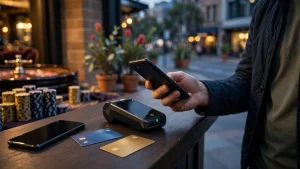
Australian payment life is built around movement between familiar tools. Contactless credit and debit cards are accepted almost everywhere, while mobile wallets such as Google Pay and Apple Pay have become similarly ordinary. A purchase can begin with a card and end with a phone held near a terminal; the underlying habit is less loyalty to one instrument than comfort with switching.
Bank-linked services sit within that same practical landscape. Australian consumers are comfortable moving between cards, mobile wallets and services such as PayPal, which connect payments to bank accounts. Each option has its own route through a transaction, but changing route is not, by itself, a novelty. The cashier has become a small map of modern finance: several doors, none of them proof that every destination lies beyond them.
That familiarity helps explain why Skrill may enter conversations about online payments. A person used to choosing among cards, wallets and bank-linked services may naturally consider another named payment service when assessing how money could be moved. But a general habit is not a merchant’s payment policy. The near-everywhere presence of contactless cards or mobile wallets in ordinary Australian commerce says nothing conclusive about whether a particular gambling site supports Skrill.
This distinction matters because payment methods are often discussed as if they travelled in a single bundle. They do not. A service can be common in shops and still be unavailable in a particular online cashier; a familiar wallet does not make every operator compatible with it. Nor does the existence of several payment routes establish that a real-money casino service is lawful or accessible in Australia.
The phrase “Australian casino with Skrill” therefore compresses two separate ideas: local payment habits and a specific site’s technical choices. Only the first is visible in the wider consumer pattern. Australian habits show adaptability, not universal acceptance. They describe how people are accustomed to paying across everyday settings, rather than confirming which options appear in any particular cashier.
A small but useful distinction. Familiarity is not availability.
Paying by Skrill at a casino is a question of whether the payment method is supported by the operator’s cashier—not simply whether Skrill is available as a wallet. A familiar payment brand does not, by itself, establish that it can be used for a particular gambling service. Acceptance is a specific connection between a payment method and an operator, rather than a general feature of the Australian market.
 Trustly Casino Sites in Australia: What Is VerifiedLearn why Trustly mentions do not confirm Australian casino acceptance, deposits or withdrawals, and what payment claims still need verification.
 Casinos That Accept Visa in Australia: What to KnowLearn why everyday Visa acceptance does not confirm casino support, and what the article says about deposits, withdrawals and payment checks.
That distinction matters because payment habits travel more easily than permissions. Cards, mobile wallets and bank-linked services may be part of everyday commerce, but their presence in ordinary transactions says nothing about whether a gambling operator can lawfully offer online casino games to people in Australia. Under the Interactive Gambling Act 2001, providing real-money online casino games to people physically in the country is illegal for operators. The Australian Communications and Media Authority enforces the Act.
So the question “which casino accepts Skrill?” cannot be treated as a straightforward shopping exercise. Naming an offshore operator as a place to play would turn a payment discussion into a direction towards a service that Australian law prohibits operators from providing. Nor does a payment logo settle the matter: it would not establish that a casino is available, that Skrill is supported for Australian customers, or that any particular transaction is permitted.
There is a quieter point beneath the technical one. A cashier is not merely a menu of convenient ways to move money; in gambling, it sits inside a legal and consumer-protection arrangement. Australian consumer law does not protect players who use offshore casinos. That absence is not repaired by a familiar wallet name or a polished payment screen.
Skrill’s general availability and casino acceptance are separate claims. Conflating them makes a payment method sound like a passport. It is not.
A $10 Skrill deposit sounds like a precise request. It is not, by itself, evidence that a casino accepts Skrill or that its cashier permits a deposit of that size. The figure describes the amount someone has in mind; the payment method and the operator’s minimum are separate questions. Treating them as one turns a budget into a claim about a service.
That distinction matters because a minimum is not a property of Skrill in isolation. It would be a condition set by an individual operator for a particular payment route, and it could not be inferred simply from the amount in a search phrase. Nor does the existence of a Skrill account establish that a casino cashier offers Skrill. A payment method, a casino’s acceptance of it, and the amount permitted for a transaction are three different things.
So the $10 question has a narrow answer: the figure cannot be presented as a confirmed Skrill deposit threshold. Any confident claim that a particular site accepts that amount would need specific, current support. Without it, the number is only the desired size of a transaction, not a dependable description of what a cashier will permit.
This is not a distinction invented for payment systems. A person may have a preferred amount in mind, while a service sets its own terms. Confusing those two turns personal budgeting into supposed product information. Search wording can make the amount appear settled; the underlying question remains unsettled.
The same caution applies to phrases such as “casino deposit via Skrill” or “Skrill casino deposit”. They can describe an intended route without proving that the route is available. They do not identify a minimum, confirm that Australian residents can use the method, or establish what conditions would apply. The grammar is compact; the facts it seems to promise are not.
Nor does “best” solve the problem. A low figure alone would not establish that a payment option is suitable, available, or lawful to offer in Australia. Ranking services on the basis of an unconfirmed deposit amount would give a veneer of comparison to information that has not been established. A number can look objective while leaving the central questions unanswered.
There is a broader point in the Australian setting. The Interactive Gambling Act 2001 prohibits operators from providing real-money online casino games to people in Australia. The fact that a payment question is framed around a small amount does not alter that boundary. Australian consumer law also does not protect people using offshore casinos. The amount does not make the arrangement safer, lawful for the operator, or covered by local consumer protections.
That does not make the figure meaningless as a description of someone’s intended spending. It simply cannot do the work of an operator’s stated minimum. A small planned deposit and a confirmed minimum are not interchangeable, and neither establishes that Skrill is accepted. The distinction is plain. The certainty is not.
For a careful account of the subject, the wording should therefore stay conditional: a $10 Skrill deposit is an amount someone may be asking about, not a threshold that can be attributed to Australian casino cashiers. No universal minimum follows from the payment method’s name, and no particular casino can be said to allow that amount on this basis.
The numbers in a payment claim can carry an authority they have not earned. A stated minimum would be a concrete condition; a requested amount is merely a proposed transaction size. Until those are kept apart, “$10” risks sounding like a promise about access where it is only a figure attached to a question.
A payment method and a game catalogue belong to different parts of an online casino’s operation. Skrill, where a service accepts it, would be a way to move funds through a cashier. It would not establish which games are available, whether a particular game can be opened from Australia, or whether the service is lawful to provide here. The cashier and the catalogue may sit beside each other on a screen; that does not make them one promise.
This distinction matters because phrases such as “casino games with Skrill” can suggest a direct connection: that a game itself accepts a payment method, or that a payment option guarantees access to particular content. Neither follows. A game does not process a deposit. A platform’s payment arrangements and its content are separate features, each subject to its own conditions.
For Australian residents, there is a more consequential separation. Under the Interactive Gambling Act 2001, operators cannot provide real-money online casino games to people physically in Australia. That prohibition covers casino-style games, including poker and table games. A payment service appearing in a cashier would not change the legal status of the service or create an entitlement to use its games. Offshore consumer protections do not fill the gap: Australian consumer law does not protect players using offshore casinos.
Skrill casino payment options, then, should not be read as a catalogue guide. A payment label cannot verify a game’s availability, and a game listing cannot prove that Skrill is accepted. Even where a platform describes both, the claims concern separate functions and can change independently. The useful distinction is plain, if less exciting than a promotional banner: payment is payment; content is content.
This is not an invitation to test the distinction by opening an offshore account or attempting a transaction. Australian restrictions apply to operators, while players are not explicitly criminalised merely for using offshore sites. That difference in legal treatment does not make an offshore service safe, approved, or protected for local customers. Access may also be actively blocked and enforced.
A casino payment label cannot turn prohibited online gambling into a permitted service. Nor can the presence of familiar game categories make a payment claim reliable. For Australian audiences, the boundary is not a technical footnote in the cashier. It is the governing context.
“Pokies” is an unmistakably Australian word, carrying the familiar shorthand of local gaming culture into a very different setting: an online search for real-money games. The word may sound domestic; the legal position does not change with the vocabulary. Under the Interactive Gambling Act 2001, operators must not provide real-money online casino games, including slots, to people physically in Australia. Online versions of casino-style games are treated as prohibited interactive gambling services when offered to customers here.
That distinction matters when Skrill appears beside pokies in a description or search phrase. A payment label does not alter the nature of the service it is attached to. Nor does the fact that a service can be reached from a device in Australia make its provision lawful. The relevant question is not whether a payment method is familiar, but whether the underlying real-money online gambling service may be offered to people in the country.
The law is directed at operators. The Australian Communications and Media Authority is responsible for enforcing the Interactive Gambling Act, while the legal framework does not explicitly criminalise an individual for using an offshore site. That difference between operator responsibility and player liability can be easy to blur in casual discussion. It should not be. The law places the prohibition on provision of the service, rather than treating an Australian player’s use of an offshore site as the same offence.
There is still a practical cost to that distance from local oversight. Australian consumer law does not protect players who use offshore casinos. A dispute involving account access, funds or a service’s terms therefore does not sit within the same consumer-protection setting as a transaction with a local business covered by Australian law. The absence of player criminal liability is not a promise of recourse, security or a remedy. A narrow legal distinction is not a safety net.
The penalties specified in the Act underline where the regulatory weight falls: the maximum daily penalty is $360,000 for an individual operator and $1.8 million for a body corporate. Those figures concern breaches by providers, not a penalty for a player simply using an offshore casino. The public policy is directed at the supply of prohibited services to people in Australia. The phrase “online pokies” may bring a familiar pastime to mind, but online real-money provision belongs to a different legal category.
This is why an Australian pokies service cannot be treated as a locally authorised equivalent merely because its pages mention Australia, display Australian currency or list a payment method. Such details, on their own, say nothing about whether the operator is permitted to offer real-money games here. The same applies to descriptions of a “mobile casino”: a phone changes the screen, not the legal status of the service being accessed.
The distinction also sets a boundary for claims about Skrill. A statement that a casino accepts Skrill, even if accurate for a particular operator at a particular time, would establish only a payment arrangement. It would not establish that real-money pokies may lawfully be provided to Australians, that the service is covered by Australian consumer protections, or that a user has a local route for resolving a dispute. Payment compatibility and lawful availability are separate matters.
Search language often compresses these questions into a single phrase: Australian pokies, Skrill, mobile access, perhaps a request for the “best” option. But each element belongs to a different inquiry. “Pokies” identifies the game category; Skrill identifies a payment service; “Australian” may describe the intended customer rather than the operator’s legal status. Combining the terms does not answer the legal question. It only makes the service sound more local than the framework allows.
The regulation reflects a deliberate choice about the supply of gambling services, not a judgement about the word people use for them. Australia’s familiar vocabulary persists; the law draws its boundary around the real-money online service itself. That boundary cannot be moved by branding, payment logos or mobile design. Familiar words. Different rules.
Skrill availability is only one part of choosing a casino site for Australia; the details below offer a concise reference to the operator information available. Check the payment options and terms directly with each site before signing up.
SkyCrown
SkyCrown lists a minimum deposit of A$30. Its stated payout times are around 10–15 minutes for crypto and 1–5 days for fiat.
JustCasino
JustCasino is listed with a licence from the Curacao Gaming Control Board.
MrPacho
MrPacho lists a minimum deposit of A$30. Its stated payout times are 30–120 minutes for crypto and 24–72 hours for fiat.
LevelUp Casino
LevelUp Casino lists a minimum deposit of A$15 and a Curacao eGaming OGL/2023/174/0082 licence held by Dama N.V.
Lucky Dreams
Lucky Dreams lists a Curacao licence and a minimum deposit of A$20 for POLi.
House of Pokies
House of Pokies lists an international iGaming licence, though the jurisdiction is not named. Its listed PayID payout time is 1–24 hours, and the PayID minimum deposit is A$10, compared with A$30 generally.
Uptown Pokies
Uptown Pokies lists a Curacao licence, has been operating since 2017, and has a minimum deposit of A$20.
WinSpirit Casino
WinSpirit Casino lists a minimum deposit of A$30 and a Curacao eGaming OGL/2024/923/0383 licence held by Antillephone N.V.
Roby Casino
Roby Casino is listed with a Curacao eGaming licence held by Roby Games Ltd.
Vegaz Casino
Vegaz Casino lists a Curacao OGL/2024/1335/0780 licence and a minimum deposit of EUR 20.
“Best” sounds like a verdict, but it has no meaning without a standard against which to judge. In a market where real-money online casinos cannot lawfully offer their services to people in Australia, the word cannot responsibly serve as a recommendation. A polished website, familiar payment branding or an appealing offer does not change the legal position.
That matters because comparisons can quietly turn into advertising. A ranked Skrill casino list, a “top site” label or a shortlist of websites would present offshore gambling services as options for Australians. Promotion of online casinos is prohibited here, and offshore operators are subject to active blocking and enforcement. The commercial language may be dressed as consumer guidance; its effect is still to direct attention towards services that cannot legally be offered to Australians.
Nor does a bonus make a sound measure of quality. Claims about casino bonuses linked to Skrill can be read as inducements, while the availability and terms of any offer are specific to an operator and may change. Treating a bonus as proof that a site is “best” also confuses an advertised incentive with a reliable assessment. There is no neutral glow around a promotion.
The payment label itself is not a quality mark. A site’s mention of Skrill does not, by itself, establish that the method is available for a particular transaction, that the displayed terms are current, or that the service is suitable for Australian residents. Those are separate questions, and a familiar brand name cannot answer them all. “Skrill casino games” similarly joins two ideas without proving that a payment method enables access to any game or platform.
A more honest use of “best” is therefore analytical rather than promotional: it asks what a claim actually establishes, who is making it, and whether the claimed service can lawfully be supplied in Australia. The distinction is especially important when an affiliate-style page presents a ranked selection as if it were an independent public service. Rankings can look like consumer protection while functioning as a sales funnel.
Australian consumer law does not protect people who use offshore casinos. That is not a minor qualification attached to an otherwise ordinary shopping comparison; it changes what the comparison can promise. In this setting, “best Skrill casino site” cannot be responsibly translated into a recommendation or a list for Australian use. At most, it describes a search for certainty—certainty that a payment method, an offer and a website all mean what their presentation suggests. A label is not that certainty.
Dry wording, perhaps. But the distinction is not.
“Instant” is an appealing word in a payment search because it seems to compress a complicated chain into one clean event. A request is made; money appears. But a withdrawal is not a single movement. It can involve an operator reviewing a request, confirming account details and releasing funds, followed by the payment service and any relevant financial institutions handling the transfer. The word on a page cannot establish how those stages work, or how long they take.
That distinction matters especially when Skrill is named. A claim about a rapid payout would first depend on the service being available for withdrawals at the particular operator. Even then, the word “instant” would need to describe a real, defined process rather than an attractive headline. So there is no sound basis for calling a Skrill casino payout instant.
There is a further complication in the phrase “real money”. It sounds like a description of the final step, but it says nothing about whether a withdrawal route exists, what checks precede it, or whether a payment can be completed. A balance shown on an account and money received through a payment service are not the same event. Between them sit rules, reviews and operational decisions that can vary by provider.
Identity checks are part of that landscape. Online gambling services commonly ask customers to establish who they are before allowing financial activity. Such checks may affect when a withdrawal request can proceed, but their requirements and timing cannot be inferred from the name of a payment method. A promise of speed that ignores verification is less a timetable than a piece of decoration.
The word “best” adds another layer of certainty that speed alone cannot supply. Nor can a mention of Skrill on a page about deposits establish anything about the route or timing of a payout. Payment methods are not interchangeable promises. A cashier’s list, where one exists, would need to distinguish the direction of payment and the applicable conditions.
Australian law supplies the larger frame, not a shortcut around these questions. The Interactive Gambling Act 2001 prohibits operators from providing real-money online casino games to people in Australia. The Australian Communications and Media Authority is responsible for enforcing that law. The legislation does not explicitly criminalise an individual player for using an offshore site, but Australian consumer law does not protect people who use offshore casinos. A payment claim cannot turn an unlawful service into a locally protected one.
The language of fast payouts often presents speed as a kindness: less waiting, less uncertainty, fewer loose ends. In ordinary commerce, that promise may be a useful feature. In offshore gambling, where the service itself sits outside the Australian legal framework, speed is a poor substitute for accountability. A quick transaction would not settle questions about legality, consumer recourse or the operator’s responsibilities. A slow one would not, by itself, explain what had happened.
Nor does the addition of “no deposit bonus” change the mechanics of a withdrawal. Promotional language can make a payout sound like a simple entitlement, but it does not establish that Skrill is accepted, that funds are withdrawable, or that a transfer has a particular speed. In Australia, advertising real-money interactive gambling services is prohibited; a bonus phrase should not be mistaken for evidence of a lawful or dependable payment arrangement.
A withdrawal involves a chain of events: the operator reviewing the request and confirming details, followed by the payment service and financial institutions handling the transfer.
A careful account of Skrill withdrawal speed therefore has to resist the neat answer implied by “instant”. The useful distinction is narrower: a speed claim is not proof of withdrawal support, and withdrawal support is not proof of immediate receipt. Those are separate questions, each requiring its own evidence.
Instant, in this setting, is not a timetable.
A Skrill deposit and a Skrill withdrawal are not interchangeable claims. Seeing Skrill listed for money paid into an account would establish only that deposit route; it would not, by itself, establish that funds could later be sent back through Skrill. The distinction matters because a payment method can sit on one side of a transaction without being available on the other.
For an Australian resident considering an offshore service, the practical question is therefore narrower than whether Skrill appears somewhere in a cashier. It is whether the operator’s current terms expressly permit withdrawals to Skrill, and what conditions apply. Those terms may distinguish between payment methods, require account checks before financial transactions, or describe separate rules for deposits and withdrawals. A method’s presence on a payment page is not a substitute for those details.
The phrase “Skrill withdrawal” can sound like a single feature. In practice, it bundles several separate points: whether the route is supported, whether an account must first have been funded by that route, whether identity checks are complete, and whether fees or other restrictions apply. None follows automatically from the word “Skrill.” No assumption about payout eligibility should be drawn from a deposit option alone.
There is also a larger boundary around the transaction. The Interactive Gambling Act 2001 makes it illegal for operators to provide real-money online casino games to people in Australia. Australian consumer law does not protect players who use offshore casinos. A payment facility cannot alter either point.
So the question is not merely whether a casino has a Skrill button. Withdrawal support means an explicit, current statement about sending funds out through that method, alongside the applicable conditions. Without that, a claim of Skrill withdrawal availability remains unsubstantiated. A small distinction, with real consequences.
A payment method and a game are separate things. Skrill may be discussed as a way of moving money, while a claim that a particular online slot accepts it would require evidence about both the game and the operator’s cashier. The two should not be collapsed into one promise: a payment logo does not establish access to a specific game, and a game title says nothing about which payment methods an operator supports.
That distinction matters especially in Australia. The Interactive Gambling Act 2001 places the restriction on operators: offering real-money online casino games, including slots, to people in Australia is unlawful. It does not make the player’s use of an offshore site a criminal offence. The Australian Communications and Media Authority enforces the Act, and access to offshore services may be blocked. Australian consumer law does not protect people who use offshore casinos.
The law is not a payment filter. Skrill cannot turn a prohibited service into a lawful one, nor does using it establish that a slot is available to Australians. Claims about “Skrill slots” can therefore blur two different questions: whether a payment option is supported by an operator and whether that operator may lawfully offer the game in Australia. Neither follows from the other.
Even a payment claim that sounds narrow can carry a larger implication: that a real-money game is ready to be used. In this market, that implication is not a neutral detail. The legal boundary concerns the service being offered, not merely the route by which funds might move. A cashier is not a licence to play.
Limits are set by each casino and can vary. Check the casino’s cashier for its current Amex deposit and withdrawal limits.
Jackpot City Casino, Spin Palace, Ruby Fortune, Ignition Casino, Joe Fortune and PlayAmo are listed as supporting Amex deposits for Australian players. Availability can vary, so check the cashier.
Yes, some online casinos accept Amex deposits, though others do not. A payment may also be declined if Amex or the card-issuing bank blocks gambling transactions.
Amex deposits are typically free, but a casino may add a 1.5% surcharge, and Amex cards incur a 3% currency conversion fee. Withdrawal fees may also apply.
Amex casino deposits are processed instantly. Withdrawals can take up to five days to clear.
Australian consumer-law protections cannot be assumed when using offshore casinos, so resolving a dispute over a payment or balance may be difficult. Australian law prohibits operators from offering online casino games to Australian residents, although it does not explicitly criminalise players for using offshore sites.
Australian consumer-law protections cannot be assumed when using offshore casinos, so resolving a dispute over a payment or balance may be difficult. Australian law prohibits operators from offering online casino games to Australian residents, although it does not explicitly criminalise players for using offshore sites.
Amex deposits are typically free, but a casino may add a 1.5% surcharge, and Amex cards incur a 3% currency conversion fee. Withdrawal fees may also apply.