The Interactive Gambling Act bars Australian-licensed operators from offering online casino games to people in Australia, shaping what can be verified.
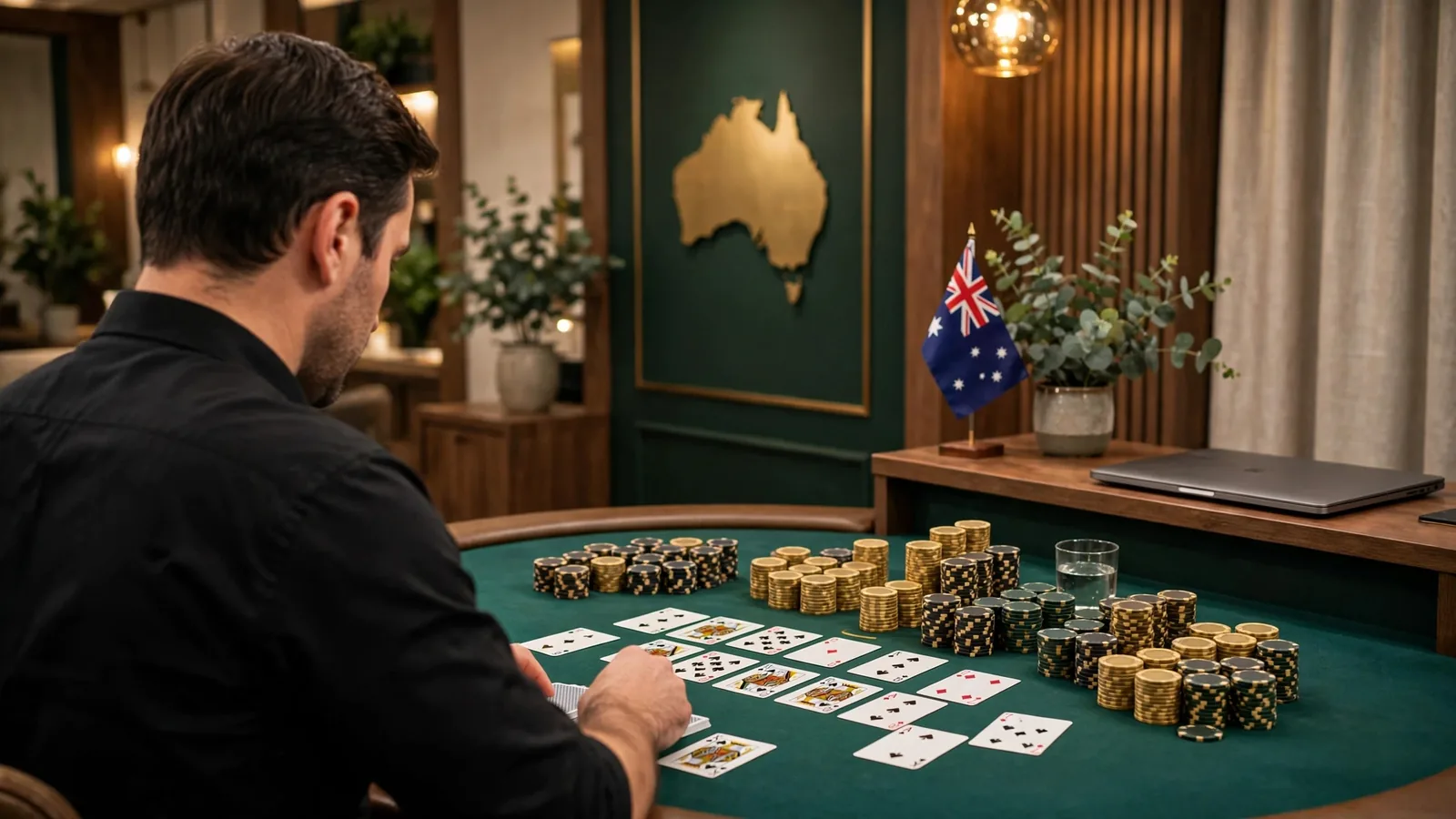
The phrase “live blackjack online casino Australia” describes a recognisable product: a table game presented through a live video stream, with a dealer and players connecting remotely. But the phrase does not describe a service that Australian-licensed operators can lawfully provide. That distinction is the starting point for understanding the local market, and it matters more than the familiar language of casino pages.
The Interactive Gambling Act draws a firm boundary around online casino games. Australian-licensed operators cannot offer them to people in Australia. Blackjack falls within that category, as do other casino-style table games. The law therefore does not create a local licensed casino market in which operators compete to offer live blackjack. There are no locally licensed online casinos officially operating in Australia.
A search for an online casino blackjack table may suggest that the usual questions are about choice: which table, which dealer, what format, what stakes. Those questions belong to a market where licensed operators can provide the product. Australia’s position comes first. A locally licensed operator cannot make the offer, however polished the interface or familiar the game may appear.
That boundary is sometimes obscured by the word “live”. In ordinary use, it points to a format, not a legal status. A streamed table may look immediate and social, but the presentation does not turn an online casino game into something outside the law’s reach. Nor does an Australian audience become a lawful market simply because a service is operated from elsewhere. The relevant distinction is between the entertainment being described and the permission to provide it to people in Australia.
The law places the obligation on operators. It is the provision of prohibited interactive gambling services that is at issue, rather than a local licensing scheme under which online casinos can apply for approval and begin offering blackjack. That is why references to an Australian casino licence can be misleading when applied to online casino play: there is no local online-casino licence to seek for this purpose, and no locally licensed online casino sector to compare.
The result is a curious split between cultural familiarity and legal availability. Blackjack is a widely recognised casino game, and “live dealer” has become a standard way to describe online tables. Yet familiarity with the format does not establish that a locally licensed version exists. A phrase can travel more easily than the service it names.
This also changes how claims about an “Australian casino” should be read. The label may refer to a site aimed at Australians, a page written for Australians, or a business that accepts Australian currency. None of those descriptions, by itself, establishes local authorisation. The Australian position is not that an online blackjack table needs a better local badge; it is that Australian-licensed operators cannot offer online casino games at all.
For readers trying to make sense of live blackjack casino pages, the safest interpretation begins with that limit, rather than with marketing language. A page may describe a product in detail, but description is not proof of lawful local operation. Likewise, the presence of a game title or a streaming image cannot settle the question of whether a service is available through a locally licensed operator. Those are separate matters.
The phrase “online blackjack casinos” can therefore point toward a category that exists in international discussion while having no locally licensed counterpart in Australia. The boundary is not a small technical qualification attached to an otherwise ordinary choice. It defines the market. The absence of local online casinos is not a temporary gap in a list of providers; it follows from the regulatory position established by the Interactive Gambling Act.
This is a less glamorous way to begin a casino guide than comparing tables or describing a dealer’s studio. It is also the more accurate one. The live format may be easy to picture, but the Australian regulatory framework does not permit locally licensed operators to offer it as an online casino game. The search term names a desire; it does not supply a lawful local product.
18+ only. Gambling involves financial risk, and losses are possible. Mafiacasino-tips-au.com is not liable for gambling losses. If gambling is causing harm, support is available through local gambling-help services.
“Live dealer” describes a format, not a promise about which game is on the table. A camera carries a casino studio to a screen; a professional dealer handles physical cards while players place bets through a virtual interface. The human presence is the point. It gives the game a visible setting and a shared pace, unlike software that generates outcomes without a dealer appearing on screen.
That distinction matters when blackjack is the game being sought. A live blackjack table may sound like a straightforward extension of the studio format, but the details of one live game cannot be transferred to another.
Baccarat also shows what “live” can mean without turning the camera into a guarantee of anything beyond visibility. The dealer and cards are real; the play is presented through a stream, and the betting takes place through the virtual table. Some games may include a chat function for the dealer and other participants. The screen connects people to a studio, but it does not make them physically present in the room.
That is a modest kind of theatre. The dealer’s hands, the cards and the rhythm of the table lend a recognisable human shape to an activity otherwise mediated by software and a screen. The camera shows a process; it does not reveal every condition governing the game. Nor does the presence of a dealer establish that two games share rules, table arrangements or betting options. “Live” names the method of presentation, not a universal set of mechanics.
For blackjack, that boundary is important. No details about a baccarat dealer’s table should be read as evidence about blackjack. The two names refer to different games, and the convenience of placing them under the same studio label does not make their particulars interchangeable.
The distinction also separates live play from RNG baccarat. In the latter, software determines outcomes rather than a dealer handling physical cards. Both may appear in online game menus, but only the live format centres the streamed dealer and physical cards. That contrast is useful for understanding the label; it still says nothing specific about the existence or operation of a blackjack table.
There is a financial dimension to the format. A specialist review describes live dealer games as often being offered for real money rather than as a cost-free trial, so participation can require a real-money bankroll. That is a description of the format, not a promise that every game or platform follows the same arrangement. The human dealer may make the screen feel less abstract; the stake remains real.
A live studio can also give a game a timetable and a pace shaped by the people and equipment involved. But the particulars of a schedule belong to the service and game being described. They should not be inferred for blackjack simply because both might be presented under a live-dealer heading.
The same caution applies to the phrase “blackjack table.” It may evoke a familiar arrangement, but a label alone does not tell how a particular online table works, what features it provides, or whether it is available. Specific claims require specific evidence. The general studio format supplies a frame, not the missing portrait.
A blackjack search may therefore meet the language of live play before it meets dependable detail about the game itself. The distinction is not pedantic. A streamed dealer and physical cards describe a real format; they do not verify every game attached to the phrase. A camera is not a rulebook.
18+ only. Gambling carries a risk of financial loss. Gamble responsibly; Mafiacasino-tips-au.com is not liable for losses.
Choosing a live blackjack casino involves more than the game itself: licensing information, deposit minimums and payout details can help you assess the options. This list highlights the details available for each operator to support your research for Australia in 2026.
SkyCrown
SkyCrown lists a Tobique Gaming Commission licence and a A$30 minimum deposit. Its stated payout times are around 10–15 minutes for crypto and 1–5 days for fiat.
JustCasino
JustCasino lists a licence from the Curacao Gaming Control Board. That licensing detail is the available point of reference for this operator.
MrPacho
MrPacho lists a A$30 minimum deposit. Its stated payout times are 30–120 minutes for crypto and 24–72 hours for fiat.
LevelUp Casino
LevelUp Casino lists a Curacao eGaming OGL/2023/174/0082 licence held by Dama N.V. Its minimum deposit is A$15.
Lucky Dreams
Lucky Dreams lists a Curacao licence and a A$20 minimum deposit via POLi. These details offer a concise starting point for assessing the operator.
House of Pokies
House of Pokies lists an international iGaming licence, though the jurisdiction is not named. Its stated PayID payout time is 1–24 hours, and PayID deposits start at A$10 within a A$30 minimum-deposit listing.
Uptown Pokies
Uptown Pokies lists a Curacao licence and notes that it has operated since 2017. Its minimum deposit is A$20.
WinSpirit Casino
WinSpirit Casino lists a Curacao eGaming OGL/2024/923/0383 licence held by Antillephone N.V. Its minimum deposit is A$30.
Roby Casino
Roby Casino lists a Curacao eGaming licence held by Roby Games Ltd. This licensing information is the available distinguishing detail.
Vegaz Casino
Vegaz Casino lists a Curacao OGL/2024/1335/0780 licence. Its stated minimum deposit is EUR 20.
“Best” sounds like a verdict, but it is really a bundle of preferences. One player may care about the pace of a table; another may care about its limits, the clarity of its rules or whether the interface works comfortably on a phone. Those are different questions, and they do not necessarily point to the same answer. A single ranking can conceal that difference beneath a tidy label.
For blackjack, a meaningful comparison would have to concern blackjack itself. A casino’s reputation, a broad games catalogue or an attractive welcome offer cannot establish how a particular blackjack table operates. Nor can details about another card game be carried across by association. In casino marketing, neighbouring games often share a lobby; their mechanics do not thereby become interchangeable.
The phrase “best online blackjack casino” therefore cannot be treated as a self-explanatory category. It invites a claim about real tables, but that claim needs particulars that can be compared on equal terms. Without named operators and blackjack-specific details, a ranking would be decoration rather than guidance. The same problem applies to lists of the best blackjack casinos: more entries do not make an unsupported comparison more reliable.
That distinction matters because the Australian setting is not simply a market with a range of locally licensed casino brands waiting to be sorted into first and second place. The Interactive Gambling Act 2001 prohibits operators from providing real-money online casino games to people in Australia, and there are no locally licensed online casinos officially operating here. That legal boundary is separate from the question of what a player might mean by “best”; it does not turn an unsubstantiated league table into a useful one.
Bonuses pose a similar problem. The word can sound like a measurable benefit, yet a headline offer alone says little about what a player can actually use or withdraw. Its terms would need to be specific to the game and clearly stated before any value could be assessed. A bonus label is not evidence that a blackjack option exists, still less proof that it is suitable. Treating the promise as the product is a familiar trick of the promotional trade.
There is a wider cultural habit at work here. People want a short answer to a complicated choice, and commercial language is eager to supply one. “Best” compresses questions about rules, access, cost and trust into a single agreeable syllable. The compression is convenient for advertising. It is less useful when the underlying service cannot lawfully be offered by Australian-licensed operators and no named, comparable blackjack options can responsibly be presented.
The honest answer to a request for the best blackjack casino in Australia is not a fabricated winner, nor a list of offshore names dressed up as independent advice. It is that no defensible ranking can be given here. That is not coyness. It is the difference between describing a choice and manufacturing one.
This subject is for adults aged 18 and over. Gambling can cause financial harm, and no outcome is assured. Mafiacasino-tips-au.com is not liable for losses arising from gambling.
Cryptocurrency sits within a broader account of payment methods associated with Australian gambling. A specialist review of payment options places crypto alongside PayID, bank transfers, Visa and Mastercard, and e-wallets. That grouping describes a category, not a catalogue of coins or a map of which games accept them.
The distinction matters when blackjack is paired with Bitcoin or Litecoin. A general reference to crypto does not establish that either coin is accepted by a particular service, that it can be used for blackjack, or that a blackjack table is available to Australian players. Turning the category into those specific claims would make the payment label carry more weight than it can bear.
There is a certain neatness to the idea: a card game associated with counting and calculation, paid for with digital units recorded on a network. But the neatness belongs to the phrase, not necessarily to any real arrangement. Payment method, game availability and the conditions attached to a service are separate questions. A coin name cannot answer all three.
Nor does the word “casino” make a payment method a promise of access. A mention of cryptocurrency in a general list says nothing by itself about whether Bitcoin or Litecoin is supported, how a deposit or withdrawal would work, or whether the same method applies across games. Those details cannot be inferred simply because crypto appears beside familiar payment categories.
This is also why a broad reference to crypto should not be mistaken for evidence of a Bitcoin blackjack service or a Litecoin blackjack table. Such phrases join two ideas—payment and game—but the connection needs its own support. Without it, the phrase remains a description of what someone might be looking for, not a dependable account of what is available.
The same restraint applies to bonus language. A bonus attached to blackjack, whether described as a welcome offer or as requiring no deposit, is a separate claim from the method used to move money. Cryptocurrency does not establish that an offer exists, what conditions govern it, or whether it applies to blackjack. Payment and promotion are different parts of the arrangement; folding them into one impression makes the terms harder, not easier, to see.
“Chips” can be equally slippery. In a game, the word may suggest counters used to represent stakes; in a digital setting, it can also sound like a token or balance. Neither meaning identifies Bitcoin or Litecoin as an accepted payment method, and neither confirms that a particular blackjack game is offered.
The responsible description is narrower: crypto is one category named among payment methods in a specialist account of Australian gambling options. Specific coins and a connection to blackjack require specific support. A tidy phrase is not a transaction.
18+ only. Gambling can pose a financial risk. Mafiacasino-tips-au.com is not liable for losses.
A blackjack strategy is often presented as a route from uncertainty to control. The appeal is understandable: a written plan seems to replace impulse with method, turning a casino game into a sequence of decisions that can be studied and repeated. Yet a plan is not a promise. No approach can make a win certain, and confidence in a system should not be mistaken for control over an outcome.
The phrase “basic strategy” carries a particular authority. It sounds like a settled foundation, the minimum knowledge required before play begins. But a label is not an explanation. Without reliable detail about the version of blackjack being played and the choices available at its table, a list of supposedly correct moves would be more performance than guidance. Familiarity with a strategy chart cannot, by itself, establish that it applies everywhere.
That caution matters especially online, where a polished interface can make a game appear more uniform than it is. A table image, a dealer’s presence or the visible equipment may invite assumptions about how a game works. Those appearances do not supply a sound basis for transferring a tactic from one setting to another. Nor does the word “online” turn a general claim into a dependable method.
Strategy also has a social life. Casino systems have long been sold in the language of mastery: discipline, calculation, composure. The language flatters the player by suggesting that uncertainty can be domesticated through sufficient attention. It also serves the seller of the system. A confident formula is easier to market than the modest truth that planning cannot guarantee a result.
This does not make preparation meaningless. It gives preparation a narrower and more honest purpose: to understand what a particular game asks of its participants, rather than to assume that a memorable rule or a borrowed chart applies to every table. A strategy should be judged by its stated conditions, not by the certainty of its presentation. Grand claims deserve particular suspicion when they promise a reliable edge but offer no clear account of where that edge comes from.
The same restraint applies to systems described as “casino strategy” or “basic strategy.” The words may refer to different advice, and repetition does not make advice authoritative. A neat table layout or a familiar shoe may look like evidence that a method fits; appearance alone cannot establish that. Details matter. So does the distinction between explaining a game and claiming that a particular sequence improves its results.
There is a further difference between strategy and financial protection. A plan for decisions is not a safeguard against loss, and no strategy should be treated as a way to recover money already spent. Gambling carries financial risk. It is restricted to adults aged 18 and over. Mafiacasino-tips-au.com accepts no liability for losses arising from gambling.
A sober account of blackjack strategy begins with that boundary: methods may organise thought, but they cannot turn uncertainty into a guarantee. The claim should remain smaller than the promise.
Questions about playing blackjack online often fold several practical matters into one: how a table works, what a payment method can do, and whether a displayed payout says anything useful about the game. Those are separate questions. Payment information can describe ways people transfer funds; it cannot establish that a particular blackjack table is available, explain its rules, or confirm how it pays.
One specialist review of Australian payment options lists PayID, bank transfers, Visa and Mastercard, e-wallets, and cryptocurrency among methods used in the country. That is a snapshot from a review, not a guarantee that every method is offered by every service, or that a method can be used for a blackjack deposit. The distinction is especially important for PayID: its presence in a general list of payment options does not establish that a PayID blackjack service exists or that a transaction would be accepted for that purpose.
Payments have their own plain mechanics. A method may be listed on a site, but the listing alone does not explain its availability, conditions, or suitability for a particular transaction. Nor does the name of a payment method tell anything about a blackjack table’s rules or payout. Money entering an account and the terms of a game are different pieces of information.
That difference can be obscured by the tidy language of online menus. A page may place a payment logo beside a casino game, giving both the appearance of a single, verified offer. Yet a logo establishes only that a method is mentioned; it does not prove that the game can be played, that the payment route applies to it, or what happens to a balance after a request to withdraw. A familiar label is not a complete set of terms.
The Australian setting adds a more fundamental limit. The Interactive Gambling Act 2001 bars operators from supplying real-money online casino games to people located in Australia. A list of payment methods does not alter that position or turn a payment route into evidence of a lawful blackjack service. The administrative surface can look ordinary; the legal boundary remains.
So the practical answer to questions about playing blackjack online in Australia cannot be built from payment names alone. PayID is among the methods identified in one specialist review, alongside bank transfers, card payments, e-wallets and cryptocurrency. That information stops there. It does not verify a blackjack table, describe how to play one, or substantiate a blackjack payout.
18+ only. Gambling can pose a financial risk. Mafiacasino-tips-au.com is not liable for losses.
A blackjack win is an event, not a dependable outcome. No approach can turn a casino game into a sure source of money, and a result at one table says little about what may happen at another. That distinction matters because the language of “how to win” can make chance sound like a skill with a guaranteed finish.
For someone entering a casino for the first time, the setting can lend the game an air of authority: the felt, the dealer, the quiet rituals around each hand. None of that makes a win more certain. A confident player can lose; a newcomer can win. Neither result proves that the person has found a repeatable method.
The casino’s edge is the term for the advantage built into a game’s structure over time. It does not mean the house wins every hand, or that a player cannot leave ahead. It describes the direction in which outcomes are designed to lean across continued play.
That is less dramatic than a winning system. It is also more useful.
Claims about the “best” way to play often blur two separate ideas: making decisions within a particular set of rules and controlling the final result. The first may concern play; the second cannot be promised. A run of wins is not proof that future hands will follow suit, just as a losing stretch does not guarantee that a reversal is due.
Online presentation can make the event feel unusually composed. A screen, a dealer and a steady rhythm may suggest that the result is legible if only the right pattern is noticed. Atmosphere is not evidence of control. The same caution applies to advice that presents a winning method as certain: confidence in the wording cannot remove uncertainty from the outcome.
A casino game can offer entertainment, tension and the small theatre of expectation. It cannot responsibly be treated as a reliable way to make money. Any decision to gamble carries financial risk, and losses remain possible. Mafiacasino-tips-au.com is not liable for losses arising from gambling. This content is for adults aged 18 and over. Gambling can cause harm; support is available for people affected by it.
The language of a blackjack site suggests a simple transaction: find a table, open an account, begin playing. In Australia, that picture runs into a legal boundary. There are no locally licensed online casinos officially operating in the country, and Australian-licensed operators cannot provide online casino games. A polished website or an Australian-facing page does not change that position.
That matters whether the attraction is a standard blackjack table, a live dealer or a variant such as blackjack switch. The label describes what a service claims to offer; it does not give the service local standing. Nor does the word “casino” on a page settle the question of who is responsible for its operation or whether it can lawfully serve people in Australia. Appearance is not authorisation.
The distinction can feel oddly abstract when a site is only a few taps away. Digital access has the manners of an open door; regulation is concerned with who is permitted to open it. Australia’s approach places the obligation on operators not to provide prohibited online casino services to people in the country. A search result, an interface or a table shown on screen cannot turn an unlicensed service into a locally licensed casino.
For that reason, naming a blackjack site as a place to play would do more than describe a web page: it could sound like an endorsement of a service that has no local casino licence.
Gambling can cause financial harm, and no account of a website can remove that risk. Mafiacasino-tips-au.com is not liable for losses arising from gambling. This material is for adults aged 18 and over. Gambling should be approached responsibly; support is available for people affected by gambling.
The absence of a local casino market is not a minor footnote to the search for an online blackjack venue. It is the condition that changes what “finding a site” can responsibly mean. A familiar game name may travel easily across borders. Permission does not travel with it.
No, the Interactive Gambling Act prevents Australian-licensed operators from providing online casino games to people in Australia.
No, "live" describes the presentation format (streamed dealer and physical cards) rather than a universal set of game mechanics.
No, the two games have entirely different scoring, drawing procedures, and betting rules.
A casino menu can place blackjack beside baccarat, but proximity is not evidence of equivalence. They are separate games, and a description of one cannot establish the rules, table format or availability of the other. Baccarat’s presence on international platforms says nothing, by itself, about whether blackjack is offered there.
That distinction matters because “blackjack” can refer to more than a name on a screen. A game listing might suggest a live table, a software-led version or simply a category label. Without details tied to a particular game, the label cannot settle which of those is meant. Nor can baccarat’s documented live and RNG formats be carried across the aisle as if game menus were legal affidavits.
The same restraint applies to the phrase “online casino games.” It is broad enough to gather very different tables under one roof, but it does not make their mechanics interchangeable. Baccarat has its own bets and dealing conventions; blackjack belongs to a different game tradition. The familiar architecture of a casino menu does not erase that difference.
There is also a social habit at work in the way games are grouped. Casinos organise choices for convenience, and search terms follow those shelves: a person looking for a blackjack table may encounter pages about casino games generally. Yet a shared heading does not make every listed game available, nor does a general account of baccarat become a guide to blackjack. Categories are useful filing cabinets. They are not proof.
For Australian readers, the broader setting remains important: online casino games are prohibited services when offered to people in Australia under the Interactive Gambling Act 2001. That legal boundary does not turn baccarat information into blackjack information, or the reverse. It simply frames the market in which such labels appear.
A blackjack game, then, should be treated as its own subject, not inferred from a neighbouring table or a casino category. The distinction is plain. The details are not transferable.
A table game’s rules are not interchangeable just because both games use cards and a dealer. Baccarat offers a clear example: its players choose between the Banker, Player and Tie bets, and the hand nearest to nine wins. Those details describe baccarat alone. They cannot establish how a blackjack hand is scored, when a player may take another card, or how a dealer must act.
That distinction matters because the familiar language of a casino table can make one game seem like a useful guide to another. It is not. In live dealer baccarat, physical cards are dealt in a streamed studio; in RNG baccarat, software determines the outcome. Neither format supplies a rulebook for blackjack. The dealer’s presence, the cards on screen and the betting interface do not make the games equivalent.
A proper account of casino blackjack rules would need to explain the decisions and outcomes that belong specifically to blackjack. Baccarat’s card values and drawing procedure cannot fill those gaps. Even its apparent simplicity—the contest to reach a total closest to nine—belongs to a different game.
The distinction is more than a matter of terminology. Rules define what players can do, what the dealer does, and how a hand ends. Borrowing them across games would produce a confident account of the wrong table. Neat, but wrong.
In Australia, the legal setting also limits what an online casino table can represent: the Interactive Gambling Act 2001 prohibits operators from providing real-money online casino games to people in the country. That boundary does not turn baccarat information into blackjack instruction. The two questions remain separate: what a game’s rules are, and whether an online service may offer it to Australians.
Online gambling carries financial risk, and Mafiacasino-tips-au.com is not liable for losses. Gambling content is for adults aged 18 and over.
Yes, Australians regularly play live baccarat through international casino platforms that accept Australian players. There are no locally licensed online casinos officially operating in Australia.
Yes. A live dealer handles physical cards in a streamed casino studio while players place bets at a virtual table.
Australian-licensed operators cannot offer online casino games, including baccarat. Australians do use international platforms, but that does not make those platforms locally licensed.
There is no guaranteed way to win. The Banker bet has the lowest stated house edge at 1.06%, compared with 1.24% on Player and 14.36% on Tie.
Players bet on Banker, Player or a tie while a dealer deals physical cards on a studio stream. The hand closest to nine wins; picture cards count as zero, and totals over 10 drop the left-hand digit.
Sometimes, but trial play is typically limited because live tables have a limited number of seats.