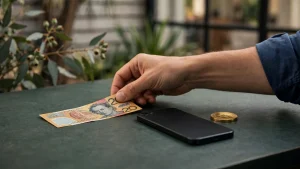
An advertised account minimum may differ from the amount a payment method accepts or the sum needed for usable play.

A one-dollar minimum can describe a narrow part of a transaction: the amount an operator says it will accept at account level. It does not necessarily describe what can be sent through the payment route shown at checkout. Those are separate thresholds, set by different parties. A low figure on a page may therefore be technically accurate and still fail to tell much about the amount needed to make a usable deposit.
The distinction is easy to miss because “minimum deposit” sounds like a single rule. In practice, an operator may set no minimum of its own, while the processor handling a payment sets one. The account interface can be willing to record a dollar; the payment service can refuse to transmit so small a sum. The advertised amount and the amount accepted at the point of payment are not necessarily the same.
That is the central complication behind claims of a $1 deposit for real-money pokies. The figure may refer to the operator’s threshold rather than a payment method available to someone in Australia. It may also describe one route rather than every route. A headline can compress those distinctions into a tidy promise; the transaction itself does not have to follow suit.
A specialist review gives a practical Australian reference point, placing the effective minimum for a usable deposit between $10 and $20 AUD. That is one review’s account, not a settled market-wide rule: payment arrangements and operator terms can change. Still, it illustrates the gap between a nominal one-dollar threshold and the amount a payment channel may actually accept. A number with a clear source and a limited scope is more useful than a supposed universal minimum.
The same distinction applies whether the account is opened on a desktop or a phone. A mobile page can make the process look shorter, but the screen does not set the payment provider’s rules. If the operator’s stated minimum is lower than the route’s own threshold, changing devices will not bridge the difference. A small deposit advertised for mobile play is not, by itself, evidence that a dollar can pass through the checkout.
Nor does an operator’s willingness to accept a small amount establish that the service may lawfully be supplied in Australia. The Interactive Gambling Act 2001 prohibits operators from providing real-money online casino games, including pokies, to people physically in the country. A low deposit claim is therefore not an endorsement or an invitation: the legal position concerns the provision of the service, not the size of the proposed payment.
For anyone trying to understand the wording, the useful question is not simply what minimum appears in a headline. It is which party sets that minimum and whether it applies to the actual payment route. An operator’s threshold answers only the first part of the transaction. The payment method has its own say.
That is where the apparent simplicity of “one dollar” falls away. A stated minimum can be real in the limited sense that the operator has not imposed a higher floor. It can still be unusable if the channel selected for payment requires more. The amount that matters at checkout is the amount the complete route will accept, not merely the smallest figure printed beside the deposit button.
The broader Australian reference point should also be read carefully. The specialist review’s $10–$20 range is an attributed observation, not a guarantee about every service or payment option. It does not prove that every deposit will fall within that band, and it does not turn a one-dollar claim into a false statement in every case. It shows why the operator’s own minimum is an incomplete measure.
A one-dollar minimum, then, is best understood as a claim about one layer of the process. It says little on its own about whether a payment can be made for that amount, and nothing about whether the service is lawful to provide in Australia. Small print may not alter the arithmetic, but it can reveal which arithmetic the headline was using.
The dollar is only the opening figure.
A $1 minimum deposit claim is worth checking against the payment-specific terms: the available details here list different minimums for some operators. Use these verdicts to see what is actually stated for each one.
SkyCrown
SkyCrown lists a A$30 minimum deposit and a Tobique Gaming Commission licence. Its stated payout times are around 10–15 minutes for crypto and 1–5 days for fiat.
JustCasino
JustCasino lists a Curacao Gaming Control Board licence.
MrPacho
MrPacho lists a A$30 minimum deposit. Its stated payout times are 30–120 minutes for crypto and 24–72 hours for fiat.
LevelUp Casino
LevelUp Casino lists a A$15 minimum deposit and a Curacao eGaming OGL/2023/174/0082 licence held by Dama N.V.
Lucky Dreams
Lucky Dreams lists a A$20 minimum deposit for POLi and a Curacao licence.
House of Pokies
House of Pokies lists a A$30 minimum deposit, or A$10 when using PayID, with PayID payouts stated at 1–24 hours. Its source describes an international iGaming licence but does not name the jurisdiction.
Uptown Pokies
Uptown Pokies lists a A$20 minimum deposit and a Curacao licence; it has been operating since 2017.
WinSpirit Casino
WinSpirit Casino lists a A$30 minimum deposit and a Curacao eGaming OGL/2024/923/0383 licence held by Antillephone N.V.
Roby Casino
Roby Casino lists a Curacao eGaming licence held by Roby Games Ltd.
Vegaz Casino
Vegaz Casino lists a Curacao OGL/2024/1335/0780 licence and a EUR 20 minimum deposit.
“Best” is a slippery word when attached to a one-dollar deposit. It can suggest that a small figure makes a service better, or that several options have been compared and one has earned a clear lead. Neither follows from the number alone. A stated minimum is only one condition among several, and it says little about whether the resulting balance can be used on the terms that matter.
A meaningful comparison would begin by separating the advertised threshold from the conditions attached to play. If a casino states that a dollar is enough to open the door, the next questions concern what happens after entry: whether the available balance can be used without breaching the rules, how wagers are counted, and whether any winnings remain eligible to cash out. A low figure cannot answer those questions by itself.
That distinction matters especially when the comparison is framed around real-money pokies. The word “best” can quietly turn a technical claim into a recommendation, as though the lowest threshold were a measure of quality. It is not. Nor does a small entry amount establish that a service is suitable for Australian players. A comparison can assess what a claim means without endorsing the service making it.
The terms governing wagering deserve particular attention. A maximum bet may apply while a wagering requirement is in force, and exceeding it can affect eligibility for winnings. Game weighting also changes how quickly different games contribute: pokies typically count in full, while table games may count far less. Those differences make the same headline offer operate differently depending on how play is counted. A comparison that records only the minimum deposit leaves out the conditions that shape the balance’s practical value.
The maximum cashout cap belongs in the same assessment. A balance may appear attractive at the point of deposit, yet a cap can limit what is payable under the applicable terms. The relevant comparison is therefore not simply between small entry figures. It is between the full conditions that govern use of the balance and the amount that can ultimately be cashed out. A small minimum does not settle that comparison.
There is also a question of what the label “Australian” signifies. Many online casinos using Australia-facing branding operate under licences issued offshore, including in Curaçao, Malta or the Isle of Man. The branding and the licence are separate facts; one does not turn the other into a local licence. For that reason, a list of supposedly best $1 deposit pokies in Australia would risk treating a familiar national label as proof of something it does not establish.
A more careful use of “best” would ask whether the claim is transparent and internally consistent. Does the stated minimum describe a deposit that can actually be made under the relevant terms? Are the wagering rules, game weighting, maximum bet and cashout cap clear enough to understand together? Does the language distinguish an advertised threshold from a balance that can be used and cashed out under those conditions? If those details are absent, a low figure is not a useful basis for comparison.
This approach also avoids confusing “lowest” with “most favourable”. The lowest stated deposit may come with conditions that make it a poor measure of value. A higher threshold, by contrast, cannot automatically be called better either; the point is that the entry figure alone cannot rank the full arrangement. The terms have to be read as a set, not as a single number detached from the rest.
The phrase “best $1 minimum deposit pokies” sounds like a neat category. In practice, it conceals several distinct tests: whether the minimum is meaningful, what restrictions apply during wagering, how games count, and what cashout limits govern the result. These are not decorative details beneath a headline. They are what give the headline any substance.
So “best” here can only mean clearest to assess—not a promise that a low-deposit service is safe, suitable or recommended. A one-dollar claim is a starting point for scrutiny, not a verdict. The small print does the judging.
A cryptocurrency payment can make a one-dollar minimum look technically possible. A specialist review has reported that some casinos set their crypto deposit threshold as low as the equivalent of A$1. That is a claim about the amount an account may accept, not evidence that a dollar will arrive intact or provide a meaningful balance for play.
The distinction is easy to miss because “minimum deposit” sounds like a single rule. In practice, the displayed threshold may be set by the casino, while the transfer itself passes through a payment network. The casino’s figure answers one narrow question: what amount it is prepared to credit. It does not answer what the transfer will cost, or how much will remain available once it has been made.
That matters especially at a very small amount. A transaction cost can take a noticeable share of a dollar-sized payment; if the cost is deducted from the amount sent, the credited balance may be smaller still. The exact result depends on the route and the terms in force. There is no reliable way to infer it from the casino’s stated minimum alone.
Then comes the game’s own entry point. A balance can be accepted by the account but still be too small to place a bet on a particular game. Minimum bets are separate from deposit minimums, and the first does not automatically adjust to accommodate the second. In that sense, the account can be funded without being practically usable.
A $1 deposit through cryptocurrency therefore describes a narrow technical threshold. It does not promise that the transfer will be economical, that the full amount will be credited, or that the remaining balance will support a bet. The difference resembles the gap between being admitted through a door and having enough room to move once inside. The threshold is real; its usefulness is another matter.
The wording on a payment page can blur these layers. A figure presented beside a cryptocurrency option may refer to the operator’s minimum, while network costs and game rules sit elsewhere in the terms. Those details are not minor footnotes when the amount is tiny: they determine whether the nominal dollar survives the journey and can be used at all. A displayed minimum should not be read as a calculation of the final playable balance.
The phrase “$1 minimum deposit” is thus more exact than it first appears, and less reassuring. It can accurately describe what an account accepts while saying very little about the practical value of the payment. A low threshold is not the same thing as a low-cost transaction, and neither is the same as a working balance.
There is also a wider Australian context: real-money online casino games, including pokies, are prohibited services when offered to people in Australia. A technical payment threshold does not alter that status. Nor does a cryptocurrency transfer turn an offshore service into a lawful local one. The distinction between a nominal amount and a usable deposit concerns payment mechanics; it should not be mistaken for an endorsement or an invitation to use such a service.
For anyone assessing the meaning of the claim, the key question is not simply whether a casino’s system accepts a dollar. It is whether the stated minimum survives the transfer costs and the game’s minimum bet. Where those conditions are not clear, the figure describes an entry point on screen, not a practical amount for play.
A dollar can be accepted. That is not the same as a dollar that works.
A one-dollar figure can appear in a claim about Australian online pokies without describing an amount that can actually be supplied through a particular payment route. Once the account is funded in Australian dollars, the relevant question is not merely what an operator says its minimum is, but what the selected channel permits. The difference is concrete: a specialist review reports that some offshore operators accept cryptocurrency deposits from A$5. That is a reported threshold for certain services, not evidence that a dollar-sized Bitcoin payment is available across the market.
The distinction matters because a payment option is not a universal doorway. A low threshold attached to cryptocurrency says nothing by itself about the minimum for a voucher, a bank-based route or another method. Nor does it establish that every operator accepts the same currency or sets the same deposit conditions. A claim about a $1 AUD Bitcoin deposit therefore cannot be carried across to all Australian-facing payment options. The number belongs to a particular route, if the checkout confirms it at all.
A$5 is still different from A$1. It may be lower than the amount required by other ways of funding an account, but it does not make the one-dollar phrase an accurate description of that route. The search for a “$1 minimum deposit” can collapse several separate things into one: an advertised threshold, a payment method’s own minimum and the amount represented by a voucher already purchased. Those distinctions are not elegant, but the checkout is not obliged to be.
Neosurf makes the voucher constraint especially plain. A Neosurf voucher typically costs at least A$10, which effectively places the deposit floor at that amount when the voucher is used. The voucher’s purchase price is not a casino-set minimum; it is the amount that must be acquired before it can fund an account. An operator might state a lower minimum in its own terms, but that statement would not reduce the cost of buying the voucher.
Some offshore operators have reported deposit thresholds as low as A$5.
Typically cost at least A$10, effectively setting the deposit floor at that amount.
One-dollar labels often do not reflect the actual minimums of specific payment routes.
This is why a one-dollar minimum for online pokies cannot be read as a general Australian-dollar entry price. With Neosurf, the stated purchase threshold begins at A$10. In the cryptocurrency claim reported by a specialist review, the minimum is A$5 for some offshore operators. Neither figure supports the idea that every payment route allows a A$1 deposit, and neither should be treated as a fixed market-wide rule. Payment conditions can differ between services and can change.
There is also a difference between naming a method and establishing that a transaction can be made at a particular amount. A page may mention Bitcoin or a voucher, but the usable figure depends on the conditions attached to that route. An amount that appears beside one method should not be assumed to apply to another. The currency label matters too: a claim expressed in Australian dollars is not interchangeable with a nominal amount stated in a different currency.
For anyone assessing what a low-deposit claim means in Australian dollars, the payment route is part of the claim, not a footnote. Cryptocurrency has been reported at A$5 for some offshore services; Neosurf vouchers typically start at A$10. The one-dollar label, by itself, settles neither figure. The checkout settles the method.
PayID sounds like a direct answer to the wish for a one-dollar deposit: a bank-linked payment route, familiar to Australians, with no voucher to buy or cryptocurrency to arrange. But the name of a payment method does not set the amount accepted at checkout. A site can list PayID while applying a minimum to deposits made through it, and the bank transfer itself does not override that setting.
One specialist review places the PayID or instant-bank-transfer minimum it found at AU$10–AU$20. That is a reported range, not a guarantee for every service or a fixed Australian rule. The amount shown in a payment screen is the practical test: a headline claim about a $1 minimum may describe the operator’s general account threshold, while PayID has its own floor. If that floor is above one dollar, choosing PayID cannot make a $1 deposit work.
The distinction is easy to miss because “instant” describes the movement of money, not its permitted size. A payment can be quick and still be unavailable for a very small amount. Nor does the fact that PayID is a familiar Australian banking feature mean that every gambling site accepts it, or accepts it on the same terms. The relevant details belong to the specific payment route at checkout.
Deposits and cash-outs also have separate clocks. A specialist review describes PayID as often allowing same-day cash-outs, but that observation concerns the time taken to receive money after a payout has been approved. It says nothing about whether a $1 deposit can be made in the first place. Treating those two speeds as one feature turns a convenient label into a misleading promise.
This is the small contradiction in PayID’s appeal. It may make a transaction feel local and immediate, yet the minimum remains a separate decision made by the service and its payment setup. A one-dollar account minimum, a PayID deposit minimum and a cash-out processing time are three different terms; none can be inferred from the others.
For anyone comparing claims of a $1 PayID deposit, the useful evidence is therefore not the payment logo or the word “instant”, but the amount the checkout actually permits for PayID. A displayed minimum above one dollar settles the question for that route, regardless of any broader claim about the account. Familiarity is not a lower limit.
A small deposit and a small cash-out are separate conditions. An account may accept a very low opening amount yet require a much larger balance before a cash-out can be requested. The first figure describes entry; the second governs when money can leave. Treating them as a single promise makes a $1 deposit sound more useful than it may be.
One specialist review places minimum cash-out limits in the A$20–A$50 range, but that is a reported range, not a settled rule across Australian-facing services. The actual threshold is set by the operator and may depend on its terms. Even at the lower end of that range, a player who began with a dollar would need a balance many times larger than the initial deposit before becoming eligible to request payment.
That difference matters because eligibility is not the same as a successful cash-out. A displayed balance below the minimum remains unavailable for payment under that threshold; a balance that reaches it can be submitted for processing, subject to the service’s other conditions. The tiny deposit may therefore be technically real money while offering no practical route to a small payout.
There is a social arithmetic to this design. Entry is advertised as a modest threshold, while the exit is governed by a separate one. The former attracts attention because it is easy to understand; the latter tends to sit in the terms, where the numbers become less inviting. A low entry price is not a low-cost promise if the balance must grow substantially before it can be taken out.
For anyone assessing claims about real-money pokies with a $1 deposit, the cash-out minimum belongs beside the deposit figure, not beneath it in fine print. The two amounts answer different questions: how little can be put in, and how much must be available before a payment request is possible. Where the latter exceeds the former by a wide margin, the headline amount says little about access to winnings.
The threshold is the other door.
An Australian flag, local spelling or reference to “Aussie” pokies can make an offshore service look domestic. The branding does not change where the operator is based or what Australian law permits. Many casinos presenting themselves as Australian operate under licences issued overseas; such a licence does not authorise them to provide real-money casino games to people in Australia.
The Interactive Gambling Act 2001 is the main federal law in this area. It prohibits operators from providing online casino services, including pokies, to customers physically located in Australia. The legal boundary falls on the service provider, not on an individual placing a bet: the Act does not make the player’s act of betting with an offshore operator a criminal offence. That distinction is easily blurred by a familiar-looking website. The branding remains branding.
The Australian Communications and Media Authority (ACMA) enforces the Act and monitors compliance with federal interactive-gambling rules. Its powers include asking Australian internet service providers to block websites that provide prohibited services or advertise them. A blocked page is not merely an inconvenience in a payment journey; it reflects enforcement against services that are not permitted to operate for Australians.
ACMA says its enforcement actions have resulted in more than 1,455 illegal gambling and affiliate websites being blocked since November 2019. Figures for services leaving the market since enforcement began in 2017 are not consistent: one account puts the number above 210, while another reports more than 190. Those figures should not be collapsed into a single precise total. The difference is a reminder that enforcement counts depend on what is being counted and how it is reported.
A claim of Australian $1 deposit pokies therefore describes a commercial pitch, not a local legal status. New branding, a small advertised entry amount or an offshore licence cannot turn prohibited online casino services into Australian-regulated ones. ACMA’s blocking activity also means that access may be interrupted. The player is not the target of the Act’s prohibition, but the service itself sits on the other side of the line.
A $1 minimum deposit for pokies can sound like a tidy way to keep the first transaction small. Yet the payment route may add its own threshold or cost, so the amount shown beside a casino’s cashier is not necessarily the amount that can be sent in practice. The friction is less visible than the headline figure, but it is part of the transaction.
Skrill and Neteller illustrate the difference. A specialist review reports that deposits through these e-wallets may carry fees and often have a minimum transaction amount of A$10. That is a meaningful gap beside a claimed one-dollar entry point: the wallet’s rules, the gambling site’s rules and any charges can all shape the sum that actually leaves the account. The fee may also make a small transfer poor value, even where the payment is technically accepted.
The word “may” matters. Fees and minimums can depend on the service and the transaction, so a broad claim about either wallet should not be mistaken for a fixed charge applying in every case. Still, a low advertised minimum does not settle what the e-wallet will permit. The checkout is where the separate conditions meet.
Bank transfers bring a different inconvenience. They are the least practical route for a low deposit because processing can take several business days, and the sending bank may charge a fee. A delay of that length changes the character of a supposedly immediate, modest payment. The money can be tied up in the route before it becomes available in the receiving account; a bank charge can further erode the value of a small sum.
This is why “small” has two meanings in payment language. One describes the amount a site says it will accept; the other describes what can be sent without disproportionate expense or waiting. With an e-wallet, the obstacle may be a transaction minimum or fee. With a bank transfer, it may be time and a possible bank charge. Neither is resolved by printing a $1 minimum beside a deposit button.
Skrill and Neteller may carry fees and often require a minimum transaction of A$10. Bank transfers can take several business days and may incur additional bank charges.
A tiny figure on a page is not the whole cost. The route has its own terms.
A first deposit advertised at one dollar says little about the value of a bonus attached to it. The promotion may require a particular minimum deposit, so a smaller payment may not qualify at all. Even when it does, the wagering requirement can make the bonus a long way from withdrawable cash.
One specialist review reports wagering requirements of 35x to 50x the bonus amount for low-deposit promotions. The multiplier applies to the bonus, not necessarily to the original deposit, so the wording matters. A bonus described as generous can still require a substantial volume of play before winnings associated with it become eligible for cash out.
Game weighting changes the calculation again. Pokies commonly count in full towards wagering, while blackjack and roulette may count at only 10% or 20%. A table game can therefore add much less progress than its stake suggests. The games available, and the contribution assigned to each, are not decorative details in the terms; they determine how quickly the requirement can be met.
The fine print should be read as a connected set of conditions: the minimum deposit that activates the offer, the wagering multiplier, and the weighting for pokies compared with table games. A promotion can be unavailable at the advertised entry amount, or its apparent value can depend on playing games that contribute less. The headline and the calculation are different things.
There is also a difference between a deposit threshold and promotional eligibility. The first describes what a payment route or account may accept; the second describes what the bonus rules recognise. Neither guarantees that the other follows. A one-dollar first payment, where accepted, does not by itself establish that a bonus applies or that its conditions are manageable.
Promotional arithmetic is often less welcoming than the headline. A small entry figure can sit beside a large wagering obligation, and the game weighting can stretch that obligation further. The smallest number on the page is not necessarily the number that matters most.
A claim that an operator has no minimum deposit can sound like a promise that a dollar will go through. It is not. The operator may set no floor of its own while the payment processor or chosen method applies a separate minimum. At checkout, that separate rule can matter more than the headline.
That distinction is central to claims about pokies accepting a one-dollar deposit. A stated minimum may describe only the operator’s account settings, not every route offered to fund it. The same account could show different practical limits depending on the channel selected. A claim that a casino accepts a dollar therefore needs to be read as a claim about a particular payment route, not a universal setting.
The checkout is where the wording meets the mechanism. If the amount entered is rejected, or the payment method requires more, the advertised figure has not made that route usable. Nor does a low first-deposit claim establish that every listed method accepts the same amount. The operator’s terms and the payment screen may describe different layers of the transaction; neither should be mistaken for the other.
There is also a piece of Australian payment history that changes how old claims should be read. POLi shut down in Australia on 30 September 2023. Any current-sounding description of it as an available local option is out of date. A page that still presents POLi as a route for a small first deposit is preserving a payment menu that no longer applies.
The sensible test is narrow: identify the method attached to the minimum claim, then see whether that method itself permits the amount stated. “No operator minimum” is not the same as “every payment route accepts a dollar.” The distinction is small on the page, and decisive at checkout.
Cryptocurrency can allow deposits as low as $5 AUD with some offshore operators, though transaction costs and minimum bets can make tiny deposits impractical. Neosurf vouchers typically start at $10 AUD, while PayID and instant bank transfers commonly require $10–$20.
Even if the casino sets no minimum, the payment method may. A usable deposit commonly requires $10–$20 AUD, although some cryptocurrency routes accept less.
The Interactive Gambling Act 2001 prohibits operators from providing certain online gambling services, including real-money casino games, to people in Australia. The Act does not criminalise an individual for placing a bet with an offshore operator.
A usable deposit commonly requires $10–$20 AUD, depending on the payment route. Low-deposit bonuses may carry wagering requirements of 35× to 50× the bonus amount.
Yes. They may require wagering of 35× to 50× the bonus amount; slots typically contribute 100% toward the requirement, while blackjack and roulette may contribute only 10% or 20%.
Yes, but withdrawals may be subject to a minimum amount, typically $20–$50 AUD. Bonus winnings can also require the wagering conditions to be met, and a maximum cashout cap may apply.
PayID withdrawals are often processed the same day, while USDT on the TRC-20 network can clear within minutes after account verification.