An offshore licence reflects its issuing jurisdiction, not permission to offer real-money casino games in Australia.
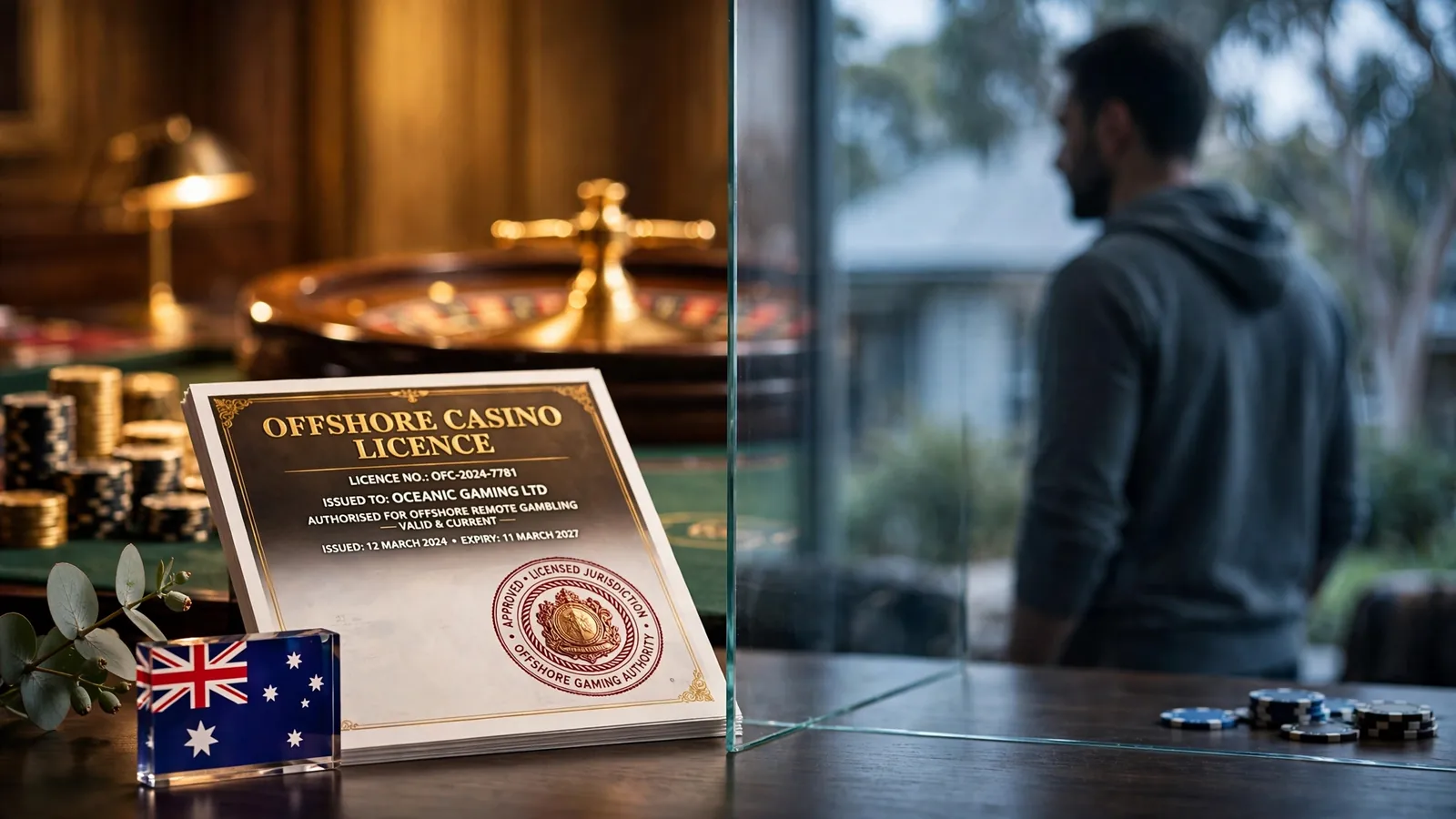
A licence issued offshore and permission to offer gambling in Australia are different things. The distinction can disappear in glossy pages where a regulator’s seal sits beside payment logos and game titles, but it remains central to the law. A Curacao licence, even if genuine in the jurisdiction that issued it, does not by itself authorise an operator to provide online casino games to people in Australia.
The Interactive Gambling Act 2001 draws the Australian boundary around the service being offered, not around the appearance of its credentials. Real-money online casino games—including slots and table games—cannot legally be provided to people physically located in Australia. An offshore licence does not displace that rule or convert a prohibited service into an Australian-authorised one. The place where a company is registered and the place where its customers are located answer different legal questions.
That distinction matters because “licensed” can sound like a universal status. It is not. A licence reflects the authority of the jurisdiction that issued it; it is not a passport accepted by every country. The phrase “Curacao-licensed casino” therefore describes a claimed relationship with an offshore licensing system, not a finding that the operator is licensed in Australia. Nor does a licence label settle whether the service may lawfully target or serve Australians.
The Australian rule is directed at operators. Under the Act, offering online casino games to Australian residents is prohibited, including when the business operates from outside the country. The legal responsibility for providing the service does not shift simply because the company’s servers, paperwork or management are elsewhere. Geography can complicate enforcement; it does not rewrite the boundary.
ACMA is Australia’s primary online gambling regulator. Its role sits within this national framework, rather than within the licensing arrangements of an offshore jurisdiction. That separation is important: an offshore regulator may have its own standards and processes, but those are not substitutes for Australian authorisation. In this market, there is no implication that an online casino becomes permissible for Australians merely by holding an offshore licence.
The position of an individual player is distinct from the position of the operator. The Interactive Gambling Act does not explicitly make it a criminal offence for an individual to use an offshore casino site. That is a narrower statement than saying the service is legal, approved or protected. The law’s focus on operators does not turn an offshore site into a locally regulated venue, and it does not create the consumer safeguards associated with a service authorised under Australian law.
That gap has practical significance. If an offshore operator withholds winnings or disputes an account, Australian law may not provide the same route to assistance that would apply to a locally authorised service. An offshore licence should not be treated as a promise that Australian authorities can resolve a customer dispute. A seal can describe oversight elsewhere; it cannot guarantee recourse here.
Claims about licensing also require care. A displayed logo, certificate or licence number is a representation by the site, not proof of Australian authorisation. Any claimed Australian licence should be checked against the relevant official register; an offshore credential is not a substitute. The distinction is not a technicality for the small print. It is the difference between a regulator’s authority over a licensee in one jurisdiction and permission to provide a particular service in another.
Using a VPN to reach a casino that is unavailable from Australia does not alter the legal character of the service. It may also breach the operator’s terms, with consequences such as account closure, voided winnings or loss of a deposit. A change in apparent location is no change in authorisation. Digital borders are theatrical; statutory ones are less so.
The language around Curacao licences can invite an easy inference: a casino has a licence, therefore it is safe and lawful for Australians. The inference has two separate failures. An offshore licence does not establish Australian permission, and a licence claim alone does not establish the level of consumer protection available to a person in Australia. The country’s approach is plainly more concerned with controlling what operators may offer than with criminalising individual customers. That is a distinction, not an endorsement.
The useful legal question is therefore not simply whether an offshore casino says it holds a licence. It is whether the service is authorised to offer online casino games to people in Australia. Under the Australian framework, an offshore licence does not supply that authority. The label travels; the permission does not.
For Australian players considering casinos with Curaçao licences, checking the licence details and practical payment information can help clarify what each option offers. Use these short verdicts as a starting point when reviewing the listed operators.
SkyCrown
SkyCrown is listed with a Tobique Gaming Commission licence. Its stated payout times are around 10–15 minutes for crypto and 1–5 days for fiat, with a minimum deposit of A$30.
JustCasino
JustCasino is listed with a Curacao Gaming Control Board licence.
MrPacho
MrPacho lists crypto payouts at 30–120 minutes and fiat payouts at 24–72 hours. Its minimum deposit is A$30.
LevelUp Casino
LevelUp Casino lists Curacao eGaming licence OGL/2023/174/0082, issued to Dama N.V. Its minimum deposit is A$15.
Lucky Dreams
Lucky Dreams is listed with a Curacao licence and a A$20 minimum deposit for POLi.
House of Pokies
House of Pokies lists an international iGaming licence, though the jurisdiction is not named. PayID payouts are stated as taking 1–24 hours, and the minimum deposit is A$30, or A$10 for PayID.
Uptown Pokies
Uptown Pokies is listed with a Curacao licence and has been operating since 2017. Its minimum deposit is A$20.
WinSpirit Casino
WinSpirit Casino lists Curacao eGaming licence OGL/2024/923/0383, issued to Antillephone N.V. Its minimum deposit is A$30.
Roby Casino
Roby Casino is listed with a Curacao eGaming licence under Roby Games Ltd.
Vegaz Casino
Vegaz Casino lists Curacao licence OGL/2024/1335/0780. Its minimum deposit is EUR 20.
A casino bearing a Curacao licence may be discussed as an offshore gambling service, but that label does not answer the Australian question. It identifies a claimed licensing connection elsewhere; it does not establish that the operator is authorised to provide online casino games to people in Australia. The distinction is easy to blur because websites often put a licence claim beside games, payment information and polished corporate language. Those details can make a service appear settled and ordinary. They do not make it licensed in Australia.
The phrase “Curacao casino” can therefore describe several different things in conversation: a casino operator claiming a Curacao licence, a website reachable from Australia, or a gambling service aimed at people in another market. These are not interchangeable categories. A site’s location, its intended audience and the legal status of its offer are separate matters. A page that loads is not evidence of permission to provide its games here; a foreign licence claim is not evidence of an Australian licence.
That matters because online gambling is not regulated by a single global passport. A licence issued in one jurisdiction cannot, by itself, settle the rules of another. For Australian residents, the relevant question is not simply whether a casino license in Curacao is displayed or described as valid. It is whether the service has the required Australian authorisation for the product being offered. For online casino games, the Australian legal position is restrictive: operators may not provide those games to people physically in Australia. A foreign credential does not change that boundary.
The word “licensed” can carry an undeserved air of completeness. In everyday life it suggests permission to do a particular thing in a particular place: a driver’s licence permits driving under the local rules, and a business permit concerns the jurisdiction that issued it. In online gambling, the same word can be made to travel farther than the document does. A Curacao licence claim may tell a reader something about the operator’s asserted regulatory relationship, but it cannot be treated as a substitute for Australian authorisation.
Nor should the question be reduced to whether Australians can open a website. Access is a technical condition, not a legal verdict. A service might be visible, unavailable, redirected or interrupted for reasons that do not establish its legal standing. Conversely, a site’s presence in a browser does not turn its offer into an authorised one. The internet is particularly good at making distance feel irrelevant; regulation is one of the institutions that insists it still matters.
For wagering services that may lawfully operate in Australia, the practical reference point is the Australian register, not a foreign licence badge. ACMA encourages people to consult its website and the national register for information about legal gambling products. Its public register can be used to check whether a wagering service holds a valid Australian licence. That is a narrower and more useful question than whether a website calls itself a Curacao casino: does the service appear in the Australian system with the relevant authorisation?
This distinction also prevents a category error. A register entry for a wagering service does not imply that every kind of gambling product is permitted, and the existence of a foreign licence claim does not place an online casino inside the Australian market. The name on the site, the jurisdiction named in its terms, and the games displayed are not interchangeable evidence. Each answers a different question.
The subject is often presented as a choice between casinos in Curacao and casinos elsewhere, as if the main issue were geography or preference. For Australians, geography alone is too blunt. The material issue is the legal status of an offer to people in Australia. A casino may be located offshore, use an offshore licence claim and still be unable to lawfully provide online casino games here. The label does not travel with the player.
That leaves a simple but important separation: “Curacao-licensed” is a claim about an offshore licensing connection; “licensed in Australia” refers to authorisation under the Australian system. One cannot be silently substituted for the other. The Australian register gives the relevant local check for wagering services, while a foreign licence does not settle the legality of casino games offered to Australian residents.
The distinction is not technical housekeeping. It is the difference between a website’s description of itself and the permission required in the place where its customers are. A licence can be real and still not be the licence that matters here.
A website can appear reachable from one place and be unavailable from another. For offshore casino services, that difference is not merely a technical inconvenience: in Australia, ACMA can ask internet service providers to block websites offering prohibited interactive gambling to Australian customers, as well as unlicensed services offered to adults in Australia. The request is directed at access through internet providers, not at a casino’s branding or the country named on its licence.
That makes enforcement visible at the point where people try to reach a site. A block may prevent an Australian connection from opening a web address, even while the service remains advertised elsewhere. It does not mean the operator has ceased trading globally; it means access from Australia has been targeted. The distinction matters because a polished website, an offshore licence claim, or a working address in another country cannot establish that the service is available lawfully to Australians.
ACMA’s tools are not limited to blocking. The regulator may also fine operators that breach the Interactive Gambling Act 2001. A block and a fine are different forms of intervention: one affects access to a website, while the other addresses an operator’s conduct under Australian law. Neither should be mistaken for a general endorsement of every site that remains accessible. Enforcement is directed at services and conduct, not at producing a public seal of approval for whatever has not yet been blocked.
The scale of the activity is substantial. Since ACMA made its first blocking request in November 2019, it has restricted access to 1,369 illegal gambling and affiliate websites. The figure includes affiliate websites, not only casino operators. That detail gives the total a wider meaning: the enforcement effort reaches parts of the promotional network that directs people towards gambling services, as well as the services themselves.
A website block is also a limited kind of intervention. It changes what an internet connection can reach; it does not, by itself, settle every question about a service’s ownership, licensing history, payment arrangements, or claims to players. Nor does a site’s continued appearance in search results or on social media show that ACMA has approved it. Online visibility is not regulatory clearance. The internet has never been especially good at making that distinction for people.
For anyone encountering a Curacao-branded casino site, the practical point is therefore about access and enforcement, not about the island’s reputation or the design of the site. ACMA’s blocking powers apply to websites offering services that fall within the Australian restrictions. A site may be blocked after a request to providers; another address associated with the same service may not be immediately treated in the same way. That possibility should not be read as permission. Enforcement does not operate as a live directory in which every unlawful service disappears at once.
Using a VPN to reach a casino after a block does not convert the service into one authorised for Australia. It may also expose the account to consequences under the operator’s own terms, including voided winnings, account closure, or loss of a deposit. A workaround changes the route taken by a connection, not the Australian status of the service. A technical detour is still a detour.
The same caution applies to affiliate pages. ACMA’s reported total includes them, showing that enforcement can encompass sites which promote or direct traffic to gambling services, not merely the sites that take bets or host games. Their presence in a referral chain does not make the destination safe or lawful. A link is a route, not a licence.
Website blocking is best understood as a practical barrier within a broader enforcement system: ACMA can seek provider-level blocks and can impose financial penalties on operators that breach the Act. The reported total shows that such requests have been used at scale, while the continuing need for enforcement illustrates the limits of treating a blocked address as the whole story. An offshore casino may still be discussed, advertised, or reachable through other means; none of those facts turns it into an Australian-authorised service. A blocked route is a signal, not a verdict on every claim the site makes.
A page displaying an offshore licence, a polished interface and familiar security symbols can look more conclusive than it is. Those details answer different questions. A licence claim concerns the operator’s stated oversight; a security notice concerns how information is handled; neither, by itself, establishes that a service is licensed in Australia.
The first check is the claim most directly relevant to the Australian market: whether the service holds an Australian licence. ACMA’s public register is the place to verify that status for a wagering service. A badge, certificate image or licence number printed on a casino page is a claim made by that page, not confirmation from the regulator. The register, rather than the site’s own presentation, is the meaningful reference point.
That distinction matters when browsing lists of Curacao casino sites or comparing services described as the best. A ranking can arrange names and present persuasive descriptions, but it cannot turn an offshore licence into Australian authorisation. Nor does the number of sites collected on a page make the list a regulatory record. For Australian readers, the useful task is not to identify a supposedly superior offshore casino; it is to establish whether the relevant Australian licence claim checks out.
A practical review can be kept to a few distinct questions:
Security language and offshore credentials can create an impression of completeness, but each has a narrower meaning than the impression suggests.
There is also a consumer-protection boundary. Unlicensed gambling services do not provide the protections attached to authorised services, and Australian laws may not help if an operator withholds winnings. That is a practical reason not to treat a site’s own assurance as independent evidence. A page can state that it uses encryption and still leave unresolved who is accountable to Australian regulators.
The careful conclusion from a site check is therefore limited: a technical security measure may protect data, while an offshore licence may describe the operator’s status elsewhere. Neither answers the Australian-register question. Where an Australian licence is claimed, the register is the check; where it cannot be confirmed, the claim remains just a claim.
A game’s information screen can describe its mechanics without answering the more important question of whether it may legally be offered to people in Australia. A Curacao connection, a familiar title or a polished help menu does not change the Australian boundary: online slots and casino games such as blackjack are illegal here.
That distinction can be easy to miss because game details look precise. A pokie may show its return to player, or RTP, in an information or help screen, often opened through an “i” symbol or a menu. The figure describes a feature of the game version being presented. It does not establish that an operator is authorised to provide online casino games in Australia.
Nor is a game’s title enough to identify its RTP. Some providers release the same game in multiple versions, each with a different RTP. The operator selects which version to run, so information attached to one version should not automatically be applied to another. The familiar artwork may remain; the underlying setting may not.
This is a small but consequential distinction. Game information belongs to the machinery of play: rules, features and the stated return. Australian legality concerns the service being offered to people in the country. One cannot stand in for the other. A displayed RTP is not a licence, and a game’s appearance in a catalogue does not make its availability lawful.
The point matters especially where offshore casinos present game libraries as evidence of legitimacy. A screen can be informative and still leave the central question untouched. It may explain how a game works, while saying nothing about whether the service may be supplied to Australians.
Precision has limits. Useful for understanding a game; irrelevant to authorisation.
Calling an offshore casino “safe” can refer to several different things: the handling of personal data, payment security, fair play, or the prospect of getting help when a dispute arises. Those are not interchangeable assurances. A site may describe its own safeguards, but that does not establish that it is authorised to offer online casino games to people in Australia, nor that Australian protections will apply if something goes wrong.
Safety is also a question of who can intervene. ACMA can ask internet service providers to block websites that offer prohibited interactive gambling services to Australian customers, as well as unlicensed services offered to adults in Australia. Blocking is not merely a technical inconvenience. It is one way the regulator can interrupt access to services that fall outside the Australian framework.
ACMA may use a blocking order as a last resort when it considers customer safety to be at risk. The qualification matters: a block is an intervention, not a routine seal of approval for every site that remains accessible. Nor does a website’s continued availability prove that it has passed a safety test. Access and authorisation are separate matters.
That distinction complicates broad claims that Curacao casinos are safe. An offshore licence, a polished site or a confident promise cannot, by itself, show what recourse an Australian customer would have. If access is blocked, the practical relationship with the operator may become harder to resolve; if a dispute arises, the existence of an offshore licence does not turn it into Australian authorisation. Assurance has a boundary.
The regulator’s ability to act is part of the safety picture, but it should not be mistaken for personal protection after a loss or dispute. ACMA can request blocks; it does not thereby guarantee that every offshore operator will honour a claim, return funds or provide an effective complaints process. A site’s own statement about safety is still a statement made by that site.
The phrase “casinos in Curacao” can also blur two separate questions: whether gambling venues exist in Curacao, and whether an offshore online casino is safe or authorised for Australians. The regulatory powers described here concern online services offered to people in Australia. They do not establish what land-based casinos operate in Curacao, and one question cannot answer the other.
In the end, safety is not a single badge. Regulatory intervention can limit access when ACMA considers customers at risk, but it does not convert an offshore service into a protected Australian one. A block is a warning, not a warranty.
Cryptocurrency can be presented as a payment feature, but it says nothing by itself about whether an online casino may legally serve people in Australia. A Curacao-branded casino that advertises digital-asset payments would still be offering the same underlying service: online gambling. Changing the payment rail does not change the character of the game.
That distinction is easy to lose in marketing. A list of coins, a wallet logo or a promise of quick transfers may make a platform appear technologically distinct; none establishes that its gambling service is authorised in Australia. The Interactive Gambling Act 2001 prohibits operators from providing real-money online casino games to people physically in Australia. The legal question concerns the service, not the currency used to fund it.
Nor does the word “crypto” establish how a transaction works in practice. It cannot, on its own, show which entity receives a deposit, whether a withdrawal is available in the same asset, how a conversion is handled, or what conditions apply. Those details depend on the individual service and its terms. Treating a payment label as a complete account of the process is a neat shortcut, but not a reliable one.
The same restraint applies to claims about the leading Curacao casinos accepting cryptocurrency. A ranking implies that the named operators and their payment arrangements have been checked; without that verification, it would turn a broad category into an endorsement. No such inference follows from the licensing label or from the presence of crypto imagery.
For Australian residents, the central issue remains the prohibited online casino service, not whether its cashier displays a conventional payment method or a digital asset. An offshore payment option does not create Australian authorisation, and a claim about cryptocurrency does not settle the operator’s legal position. The technology may alter how money is described or routed. It does not redraw the boundary set by Australian law.
That is the distinction worth keeping: payment claims describe a proposed transaction; they do not establish permission to provide online casino games in Australia. A wallet symbol is not a licence.
In 2026, a Curacao licence claim still needs to be read for what it says—and for what it does not. It may describe an operator’s status under an offshore licensing system. It does not, by itself, establish permission to offer online casino games to people in Australia. A foreign credential and Australian authorisation are different things.
The relevant boundary is set by the Interactive Gambling Act 2001. It prohibits domestic operators from offering online casino games to Australian residents. The date in the search for a Curacao casino licence for Australian players does not alter that rule: a licence issued offshore cannot rewrite Australian law or turn a prohibited service into an authorised one.
That distinction can get blurred in the language of a website. “Licensed” may sound like a complete answer, though it leaves out the essential question: licensed where, and for what market? A statement about an offshore licence should not be presented as evidence that the operator is licensed in Australia. Nor does a badge, certificate image or claim of regulatory oversight settle the Australian question.
The Interactive Gambling Act 2001 does not explicitly make it a criminal offence for an individual to use an offshore casino site, though this differs from the service being officially approved or authorised.
The law draws a separate line around individual players. The Interactive Gambling Act does not explicitly make it a criminal offence for a person to use an offshore casino site. That is not the same as official approval, and it does not confer Australian authorisation on the operator. The legal position of the service and the criminal liability of the individual are not interchangeable.
This is why a year-specific answer should be modest. The 2026 label can date an explanation; it cannot supply a local licence that the law does not recognise. Offshore status remains offshore status. Australian rules remain the boundary for services offered to people in Australia.
“New” is a moving label. It may refer to a recently launched site, a changed brand or simply a fresh marketing claim; the word alone establishes none of these. Nor does a Curacao connection, stated or implied, establish that an operator is suitable to recommend to people in Australia.
A responsible recommendation needs more than a name and a polished launch announcement. The operator’s identity and the claims attached to it need to be independently substantiated. Without that, listing a site would turn an untested description into an endorsement. That is not a small editorial distinction when real money and personal details are involved.
A list built from promotional labels would look precise while offering no dependable basis for comparison. Neat formatting cannot supply what verification would require.
There is also an Australian boundary that a launch date cannot alter. The Interactive Gambling Act 2001 makes it illegal for operators to provide real-money online casino games to people in Australia. A new brand does not create an exception. The law does not explicitly criminalise individual players for using offshore casino sites, but that distinction does not turn a site into an authorised local service.
The cultural appeal of the “new” is easy to understand: novelty suggests discovery, and discovery suggests an advantage. In gambling, that suggestion can do quiet work on behalf of a seller. Here, restraint is more useful than a speculative roll-call. No names, no borrowed confidence.
Whether Curaçao has land-based casinos is a geographical question, not a licensing question. The two subjects are easily blurred because the same place-name appears in discussions of offshore online gambling. But a licence associated with Curaçao does not, by itself, establish what venues operate on the island, where they are located, or what forms of gambling they offer in person.
The distinction matters in Australia, where the legal frame concerns services offered to people in the country. Under the Interactive Gambling Act 2001, operators cannot provide real-money online casino games to Australian residents. That rule says nothing about the existence or status of physical casinos in Curaçao. Nor can the presence of a gambling licence be used to infer that a land-based venue exists there. Different questions require different evidence.
A place can be associated with online licensing without that association serving as a guide to its streets, buildings or visitor attractions. The label travels more readily than the facts. It may appear on a website’s terms or in promotional material, but that does not turn it into a description of the island’s physical gambling venues.
The reverse inference is just as weak. Even proof that a land-based casino exists somewhere would not establish that an online service bearing the same jurisdictional label is authorised to serve people in Australia. A physical venue and a remote service belong to different regulatory and practical settings.
So the Australian rules clarify only the Australian boundary: online casino services cannot lawfully be offered to people in Australia under the offshore label. They do not answer whether Curaçao has land-based casinos. That question should be settled through reliable, location-specific information about venues, rather than inferred from an online licence. Distinct matters; distinct proof.
Using an offshore casino is not explicitly a criminal offence for an individual under the Interactive Gambling Act 2001. However, an offshore licence does not make the service authorised in Australia or guarantee local consumer protections or help resolving disputes.
Options mentioned include PayID, e-wallets, bank transfers and cards; POLi is mainly for deposits. PayID and some e-wallet payments can be quick after approval, while bank transfers and card withdrawals may take several business days or may not be available.
You may be asked for photo identification, proof of address and proof that you own the payment method used. Identity checks are commonly required before withdrawals.
Licensed operators are required to follow responsible gambling rules, and licensed platforms may offer daily, weekly or monthly deposit limits. Reputable platforms also provide information about gambling-related harm and direct users to professional support services in Australia.