Australia has no domestic online-casino licences, so claims about payments, bonuses and verification need to be assessed in an offshore context.
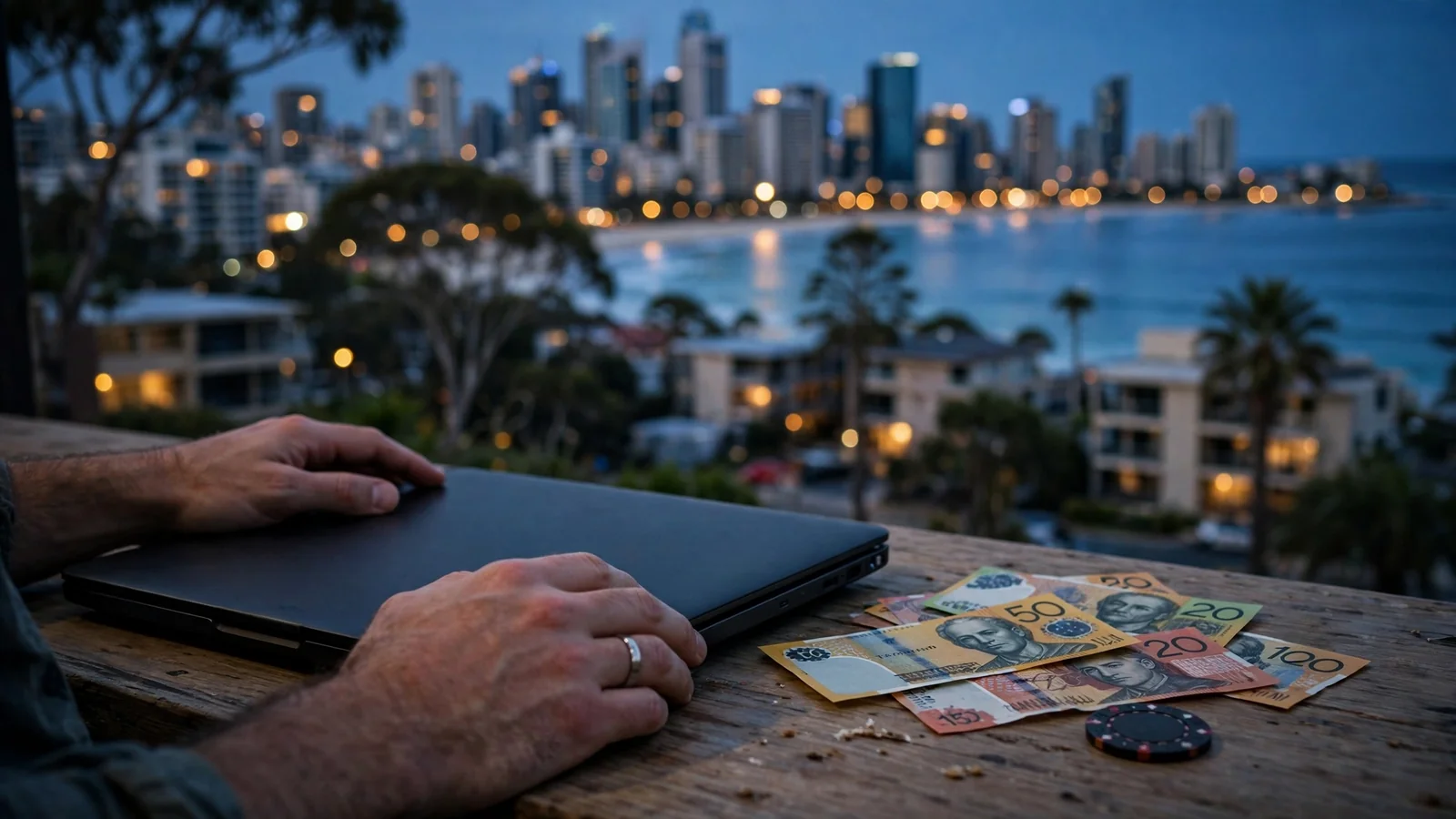
The phrase “online pokies for real money in Australia” describes a familiar wish, but not a domestic casino market. Australia has no online casino licensed under its own law. That absence is the central fact behind every offer presented as Australian: if a company accepts a person located in Australia for real-money pokies, it is operating from offshore, not under an Australian online-casino licence.
The distinction is easy to blur because a website can be accessible, use Australian currency or address Australian players without becoming an Australian operator. Location, branding and the language of an offer do not create a local licence. Under the Interactive Gambling Act 2001, companies are prohibited from providing real-money online pokies to Australian residents without domestic authorisation. No such licences have been issued. There is therefore no lawful domestic licensing route for an online casino to offer these games to people in Australia.
That rule is directed at the company providing the service, not at the individual player. Australians are not made criminally liable simply for playing on an offshore site that accepts them. This is a consequential distinction: the law places the obligation on operators, while the practical availability of a site may leave a player dealing with a business beyond the protection of Australia’s online-casino licensing system.
Choosing an online pokies site for real-money play in Australia calls for checking practical details as well as licensing information. This list highlights the facts available for each operator to help you assess what matters to you.
SkyCrown
SkyCrown lists a Tobique Gaming Commission licence. Its stated payout times are around 10–15 minutes for crypto and 1–5 days for fiat, with a minimum deposit of A$30.
JustCasino
JustCasino lists a Curacao Gaming Control Board licence.
MrPacho
MrPacho states crypto payouts take 30–120 minutes and fiat payouts 24–72 hours. Its minimum deposit is A$30.
LevelUp Casino
LevelUp Casino lists a Curacao eGaming OGL/2023/174/0082 licence, associated with Dama N.V. Its minimum deposit is A$15.
Lucky Dreams
Lucky Dreams lists a Curacao licence and a minimum deposit of A$20 via POLi.
House of Pokies
House of Pokies lists an international iGaming licence, but the jurisdiction is not named in the source. PayID payouts are stated as taking 1–24 hours, and PayID deposits start at A$10 (the general minimum deposit is A$30).
Uptown Pokies
Uptown Pokies lists a Curacao licence and has been operating since 2017. Its minimum deposit is A$20.
WinSpirit Casino
WinSpirit Casino lists a Curacao eGaming OGL/2024/923/0383 licence, associated with Antillephone N.V. Its minimum deposit is A$30.
Roby Casino
Roby Casino lists a Curacao eGaming licence under Roby Games Ltd.
Vegaz Casino
Vegaz Casino lists a Curacao OGL/2024/1335/0780 licence. Its stated minimum deposit is EUR 20.
Access is not the same as assurance. A site may accept Australian customers, but that fact does not turn its offer into a locally regulated service. Nor does the familiar vocabulary of “Australian pokies” alter the legal status of the operator. The market’s geography is unusually plain: the player may be in Australia; the casino, and the rules governing its promises, are elsewhere.
The gap between permission for a player and prohibition for a provider can sound contradictory. It is not. The law can bar companies from supplying a service to people in Australia while not imposing a penalty on those people for using an offshore service. The result is a market in which real-money play may occur, but no Australian-licensed online casino stands behind it. Availability survives without domestic authorisation. A neat arrangement, except for the player.
That distinction matters most when something goes wrong. If an offshore casino refuses to pay winnings, an Australian player has no legal recourse in Australia against it. The absence of a local licence is not merely a label on a website or a technical detail in its terms. It marks the absence of the domestic licensing framework that would otherwise govern an online casino operating here. A claim made by a business abroad may therefore be difficult to turn into an enforceable remedy at home.
The word “legal” needs care in this setting. It can refer to the operator’s conduct, the player’s conduct, or the presence of a local regulatory framework; those are not interchangeable questions. The operator’s position is clear: offering real-money online pokies to Australian residents without a domestic licence is prohibited, and there are no Australian online-casino licences to obtain. The player’s position is different: the law does not make the act of playing on an offshore site an offence. But that does not mean the service itself has domestic approval, or that a player gains the protections associated with a locally licensed casino.
For anyone considering real-money play, the result is a narrow and important reality rather than a recommendation. An offer accepting customers in Australia is an offshore offer. There is no Australian-licensed online casino to distinguish one such offer as a domestic alternative, and no Australian remedy if an offshore operator withholds winnings. The legal burden and the financial exposure do not sit in the same place.
This is why the words “Australian casino” can mislead when they are used to describe an online service. They may indicate the audience a business seeks, not the jurisdiction that licenses it. A local audience does not make a local institution. In the case of online pokies, that difference is the whole story behind the phrase “real money”: the money may be real, while the regulatory relationship remains offshore.
PayID is not a gambling account or a special kind of online wallet. It is an alias layer within Australia’s New Payments Platform (NPP): instead of entering bank account details, a sender can use an identifier such as an email address, mobile number or ABN. The alias points to a bank account, and the NPP carries the transfer between participating institutions.
That distinction is easy to lose when a payment option appears beside a list of games. The name belongs to the transfer system, not to the business receiving the money. PayID can identify where a payment is directed; it cannot establish that the recipient is authorised to offer online gambling in Australia, or that a game operates fairly.
The NPP is supported by all major Australian banks and uses end-to-end encryption. Those are attributes of the payment infrastructure. They describe how transfers are carried, not the legal standing or conduct of every merchant that may request one. A secure rail can carry money to a recipient without endorsing that recipient. The plumbing has no opinion.
For an Australian online casino to accept a real-money PayID transfer, the payment arrangement requires PayID to be linked to a bank account first. The alias does not hold a separate balance in the way a standalone wallet might. It is a route to the account behind it. In practical terms, the transfer still depends on the bank account and on the bank’s willingness to process the transaction.
That last condition matters. Australian banks and card companies are increasingly blocking transactions to known gambling sites, according to specialist gambling reviews. Separate reporting in specialist reviews notes that some Australian banks, including members of the Big Four, occasionally block PayID transfers to known gambling merchants. These descriptions concern reported payment restrictions, not a promise that every bank will act in the same way or that any particular transfer will succeed. Banking policies can change, and a payment method’s presence on a site does not override them.
A rejected transfer is not evidence that PayID itself has failed. The interruption may come from a bank’s controls, from the recipient’s payment arrangements, or from other checks in the chain. Nor does a completed transfer prove that the recipient is legitimate. It confirms only that money moved through the payment process. Those are different questions, even when a website presents them as one smooth transaction.
The wider Australian context cannot be separated from this distinction. The Interactive Gambling Act 2001 prohibits operators from providing real-money online casino games to people in Australia, and no domestic online-casino licences have been issued. A site describing itself as PayID-friendly does not acquire Australian authorisation through that description. PayID support is not a licence, a regulator’s approval or a test of a game’s fairness.
This is especially relevant to phrases such as “PayID pokies” or “PayID real-money pokies”. They describe a requested way to transfer funds, not a category of casino with a separate legal status. The payment rail does not make prohibited services permissible, and it does not alter the protections available to someone dealing with an offshore operator. Australia’s legal framework targets the operators rather than individual players, but that distinction does not turn a payment provider into a safety certificate.
The appeal of an alias is plain: it replaces a string of account details with a familiar identifier. It can make the act of sending money look ordinary, because the same underlying network serves everyday transfers. Yet the familiarity belongs to the rail. The destination remains a separate matter, and a polished payment screen can obscure that separation without changing it.
A bank’s refusal can therefore be more than a technical inconvenience. It reflects the fact that institutions may apply their own restrictions to gambling-related transactions, while the payment system itself remains general-purpose. There is no contradiction in a network supporting transfers across the banking system while a bank blocks a particular merchant payment. The network provides the mechanism; the bank controls whether to permit a given transaction.
PayID can move money. It cannot certify the casino at the other end, confirm that an online pokie has a particular return setting, or promise that funds will be treated as a lawful Australian casino payment. Those judgments do not come bundled with an alias.
A pokie spin does not remember the one before it. Each is an independent event, with its outcome determined by a Random Number Generator (RNG). A run of losses does not make a win more due; a recent win does not make another one less likely. The machine has no sense of sequence, debt or dramatic timing. It simply produces an outcome for each spin.
That independence can be easy to forget in play for real money. A sequence invites interpretation: a near miss looks like a warning, a cluster of wins like a pattern, a long quiet stretch like a promise. These are human readings imposed on events that, spin by spin, do not build a memory. The next result is not a reply to the last one.
This does not mean every game has the same underlying return setting. RTP, or return to player, describes a game’s return percentage over extended play; it is not a forecast of what an individual session will deliver. Some providers allow casinos to choose between more than one RTP setting for a particular pokie. A specialist review reports that this can leave the same game with different return percentages at different casinos.
That distinction matters. A familiar title or visual design does not, on its own, establish that the game is running at the same setting elsewhere. The game may look unchanged while its selected RTP differs. The practical detail is not a promise about what any spin will do, but a reminder that a name alone may not tell the whole story.
Nor does an RTP figure settle the question of a particular outcome. A percentage describes a theoretical return across a very large number of plays, not a minimum return or a timetable for receiving it. Short sessions can diverge sharply from that long-run measure. The randomness of each spin is the reason: the average is not a schedule.
This is where talk of “hot” and “cold” games becomes seductive. Human beings are skilled at seeing shape in repetition; the mind would rather find a run of luck than accept a string of unrelated results. But an independent RNG spin offers no evidence that the next one will continue or reverse a streak. A pattern observed after the fact is not a mechanism that controls what follows.
For someone comparing online pokies for real money, the two mechanics therefore belong side by side, but should not be confused. The RNG governs the individual result. The selected RTP setting concerns the game’s theoretical return over a great many results. One does not make the other predictable. A higher stated return, where that information is available, cannot identify the next winning spin or guarantee that a short session will resemble the long-run figure.
The same caution applies to play described as free. A free-play experience may let someone see how a game behaves on screen, but the word “free” does not turn random outcomes into evidence about a cash session. Nor does a display of wins establish a future pattern. The mechanics of an individual spin remain random; the context in which play occurs does not erase that uncertainty.
For real-money play, the useful question is not whether a game seems due. It is whether the information about its RTP setting is clear enough to distinguish one version from another. Where several settings are available to a casino, a game title by itself may not identify which one is in use. This is a narrow point, but an important one: apparent familiarity can conceal a material difference.
Randomness is not a personality. It does not reward patience, notice frustration or respond to a player’s theory of the machine. Each spin stands alone, while the RTP describes a much larger statistical horizon. Between those scales lies the ordinary human temptation to treat chance as conversation.
It is not.
A bonus can look substantial on the screen while its wagering condition quietly changes what it is worth. The key figure is the turnover multiplier: the number of times a specified amount must be wagered before the bonus-related balance becomes withdrawable. It measures required betting, not the amount a player must lose. A completed turnover condition does not mean that the same amount remains in the account.
The calculation depends on which amount the multiplier applies to. If it applies to the bonus alone, a $500 bonus with a 40x requirement calls for $20,000 in total bets before winnings can be withdrawn. That is turnover, not a bill for $20,000: successive wagers count towards the requirement, whether or not each one wins. But the arithmetic does not remove the uncertainty of play. A balance can fall before the required turnover is completed.
A different term may apply the multiplier to the deposit and bonus together. With a $500 deposit and a $500 bonus, a 35x requirement on the combined $1,000 means $35,000 in bets. The same multiplier therefore produces a different hurdle according to its base. “35x” on its own is not a complete description; the terms need to say whether it refers to the bonus, the deposit, or both.
A specialist review has suggested treating requirements of 35x or less as a more restrained benchmark, while describing anything above 40x as punishing. That is an assessment, not a universal rule. The practical point is simpler: the multiplier and the amount it applies to must be read together. A lower multiplier on a larger base can still demand more turnover than a higher multiplier on a smaller one.
Bonus Turnover Calculation
Identify the base
Determine if the multiplier applies to the bonus amount alone or the combined deposit and bonus.
Apply the multiplier
Multiply the base amount by the turnover requirement (e.g., $500 bonus × 40x = $20,000 total bets).
Meet the requirement
Place successive wagers until the total amount bet reaches the calculated turnover figure before withdrawing winnings.
This distinction matters to anyone weighing whether an online pokies bonus can translate into money they can actually take out. The promotional figure is not cash already earned. It is conditional credit, attached to rules that govern how much must be wagered and when the resulting balance can be withdrawn. The headline number is only the beginning of the calculation.
Free spins have their own arithmetic. They may produce winnings, but a free-spin offer can also set a cap on the amount that is eligible to be cashed out. A large result on the screen is therefore not necessarily the amount that can leave the account. The cap limits the payable winnings from the offer; it is separate from a wagering multiplier, which concerns how much betting must occur.
That makes two questions important in any offer’s terms: what turnover is required, and whether a maximum applies to winnings from free spins. One condition concerns the route to withdrawal; the other may restrict the destination. Neither is a measure of how likely a spin is to win, and neither turns a promotional balance into an unconditional payout.
The language of “win real money” can compress all these stages into one appealing phrase. The arithmetic restores the missing steps: a bonus has a base, a multiplier, and possibly a cash-out cap. The conditions determine what a win means in practice. A headline offer is not the whole sum.
A small deposit is only the first figure in a longer transaction. A specialist review of offshore casino payment terms reports minimum deposits commonly set between AU$10 and AU$20, with some operators accepting AU$5. Those thresholds describe entry, not the amount needed to meet a promotion’s conditions or the ease of getting a balance back. The distinction matters: money can travel inward in one step while its return is governed by separate rules.
A deposit made through PayID is still a transfer from a linked bank account; the payment method does not settle what happens at withdrawal. The operator’s cashier terms determine the available cash-out route and any limits attached to it. An apparent balance is not the same as funds already received. The exit has its own paperwork.
Withdrawal ceilings can make a large win a slow-moving sum. A specialist review of casino payout terms reports weekly or monthly caps in the range of $5,000 to $10,000 at some casinos. Under such a cap, a $50,000 jackpot could be paid in instalments over years rather than arriving as one transfer. The arithmetic is plain; the practical consequence is less so. A limit is not merely a line in a cashier page when it governs how long a player waits for money already shown as won.
The first withdrawal may also bring identity checks. A specialist review of operator verification procedures reports requests for a photograph of an identity document and proof of address, with some operators also asking for a selfie holding the document. These checks are commonly placed before the first cash-out, so an account that accepted a deposit without much friction may still pause when a withdrawal is requested.
The useful preparation is administrative rather than strategic: identity and address documents need to be ready before the first withdrawal is submitted. Names and details should correspond across the account and paperwork, because a mismatch can complicate review. The exact documents and process depend on the operator’s stated terms; the payment button alone cannot explain them.
“Instant” describes a payment promise, not necessarily the whole journey from deposit to money in a bank account. The transfer into an account, the operator’s approval of a withdrawal, identity review and any payout ceiling are distinct stages. A quick first step says little about the last one.
That is the shape of the transaction: a modest entry point, rules at the exit, and verification between the two. In an offshore setting, those terms deserve attention before money is sent, not after a balance becomes difficult to move. The cashier is not the whole story.
“Australian” can describe the person playing, the currency displayed or the audience a website seeks. It does not describe a domestic online-casino licence. Under the Interactive Gambling Act 2001, companies cannot lawfully offer real-money online pokies to people in Australia without a local licence, and no such licences have been issued. An offshore site accepting Australian customers does not acquire one by doing so.
That distinction leaves an awkward gap between access and authorisation. The law is directed at operators, not individual players: Australians are not made criminals simply by playing on an offshore site that accepts them. But a player’s ability to reach a website does not turn its service into a locally licensed one. A border can be legally firm and technically porous at once.
ACMA, the Australian Communications and Media Authority, enforces the Act. It can direct internet service providers to block access to offshore gambling sites that breach the law, and providers must comply with its blocklist. Blocking is an enforcement measure, not a certificate about the sites that remain reachable. Nor does a site’s temporary availability establish that Australian law recognises its offer.
The word “Australian” in descriptions of real-money pokies therefore carries less assurance than it may appear to. It may point to the intended market, but it cannot supply the missing domestic authorisation. There is no Australian-licensed online casino. The distinction matters especially when a dispute arises: people playing with an offshore casino have no legal recourse in Australia if it refuses to pay winnings. Access is not protection.
Age rules are separate and straightforward. The legal threshold for gambling in Australia, including online pokies, is 18. Being old enough to gamble does not alter the status of an offshore operator, just as the operator’s acceptance of a local customer does not create a local licence.
BetStop requires a similarly careful boundary. It applies to Australian-licensed operators and does not bind offshore sites. A person’s exclusion through BetStop therefore cannot be assumed to prevent access to an offshore casino. The system has a defined jurisdiction; the internet does not make that jurisdiction universal.
An app can make a gambling service feel local. Its icon sits beside banking and transport tools; its name may use Australian spelling; its interface may be designed for a phone. None of that changes who is providing the game or the legal status of the service.
For real-money pokies, the relevant distinction is not between an app and a browser. The Interactive Gambling Act 2001 makes it illegal for a company to offer these games to people in Australia without a domestic licence. No domestic online-casino licences have been issued, and there is no Australian-licensed online casino. A mobile application cannot supply a licence that the market does not have.
That is why claims about an Australian real-money pokies app need to be read as claims about access to an offshore gambling service, not evidence of an Australian-regulated product. The word “Australian” may describe the audience being targeted or the way a service presents itself; it does not establish that an Australian authority has authorised the operator. A polished screen is not a legal instrument.
Nor does the form of access change the consequence if a dispute arises. If an offshore casino refuses to pay winnings, an Australian player has no legal recourse in Australia. An app’s presence on a device does not alter that position, just as opening the same service through a browser would not turn it into a domestic casino.
There is a social reason the distinction can be easy to miss. Software compresses distance: an offshore service may appear as close as a local business, while its legal and commercial responsibilities remain elsewhere. The interface offers immediacy; accountability does not necessarily travel with it. This is not an app-specific risk but the same offshore exposure attached to online play.
The limits of what can be established from an app label are therefore substantial. The label alone says nothing about Australian licensing, and a familiar design cannot fill that gap. The decisive point is the operator’s status, not whether the game arrives through an app or a webpage. In Australia, the absence of a domestic online-casino licence leaves no locally licensed real-money pokies app to identify. A different doorway, same legal landscape.
A phone changes the shape of the screen, not the legal character of the service on it. A pokie reached through a mobile browser remains an online game for real money; moving it from a desk to a train seat does not create a separate category of play, or a special Australian licence.
Under the Interactive Gambling Act 2001, companies cannot lawfully offer real-money online pokies to people in Australia without a domestic licence. None has been issued. That leaves a peculiar division: the law places its prohibition on operators, not on individual players, and Australians may play at offshore sites that accept them. The mobile setting does not redraw that boundary.
The distinction is easy to blur because a phone makes a distant service feel local. A familiar banking screen, a site laid out for a small display, or a game that opens with a tap can give offshore activity the texture of an ordinary domestic transaction. Yet appearance is not jurisdiction. The device is merely the doorway; the operator’s position under Australian law is a separate matter.
That does not mean every offshore site will accept Australian customers, nor that access on a phone is assured. The legal position describes who the law targets and what operators may offer; it is not a promise that any particular service is available. Nor does a mobile connection turn an offshore operator into an Australian-licensed one. There is no such domestic online-casino licence to confer.
The phrase “mobile pokies for real money in Australia” therefore describes a way of reaching the same offshore market, not a lawful mobile exception. The small screen can make the arrangement seem personal and immediate. The underlying rules remain less intimate: they address the company supplying the game, while leaving the player outside that particular prohibition.
A different screen. The same boundary.
A newly launched real-money pokies site can look like a fresh beginning; legally, it enters an old arrangement. The Interactive Gambling Act 2001 prohibits operators from providing online casino games to people in Australia, and no Australian online-casino licences have been issued. The law targets providers rather than players, but that distinction does not create an Australian remedy when an offshore casino withholds winnings. There is no legal recourse in Australia against such an operator.
That is the first question behind any new-site offer. A polished launch, a local-facing name or a payment option does not change the operator’s position. Nor does PayID, a way to move money, establish that a casino is licensed or that its games are fair.
The game itself may also be less fixed than its familiar title suggests. Some providers let casinos choose among different RTP settings for the same pokie, so the return percentage can differ between sites. A figure shown for one version should not automatically be assumed to describe the version available elsewhere. The name stays put; the setting may not.
Then comes the point at which an account balance is supposed to leave the site. A specialist review reports that casinos commonly ask for identity checks before a first withdrawal. These can include an identity document, proof of address and, in some cases, a selfie holding the document. Those requirements matter before money is won, not merely when a payout request is made: an account that has not passed the operator’s checks may face difficulty at the exit.
Newness settles none of these questions. Offshore exposure, the RTP setting attached to the game and the documents required for verification remain separate matters to assess. Fresh paint, old uncertainties.
A site described as serving players in Papua New Guinea may be read as belonging to a particular jurisdiction, but a label alone establishes very little. It does not identify the company behind a service, show where that company is licensed, or confirm that an offer is available to Australians. Those are separate claims, and they cannot be inferred from the words “PNG” or “real money”.
For people physically in Australia, the relevant legal distinction is not the label attached to an overseas service. Under the Interactive Gambling Act 2001, companies may not provide real-money online pokies to Australian residents without a domestic licence. No domestic online-casino licences have been issued. A PNG connection, if claimed, does not turn into an Australian licence by proximity, branding or a currency display.
The law is directed at operators rather than individual players. Australians may play on offshore sites that accept them, but that does not establish that a particular PNG-labelled service accepts Australian customers, complies with rules in Papua New Guinea, or will honour a withdrawal. None of those conclusions follows from the label alone.
This is a small but consequential distinction. A place name can function as a hint about an operator’s intended market, or merely as decoration; without verified details, it cannot serve as evidence of either. Nor does a page describing a service settle whether it is legally entitled to provide gambling to someone in Australia.
The Australian position remains clear even when the identity behind a PNG reference does not: there is no domestic licence for online casinos, and offshore branding does not supply one. The rest requires evidence, not inference.